Tuesday, 21 March 2017

Riveting the canopy - a special

The crew assembling the new Broadway canopy were very kind to demonstrate the use of the riveter today.

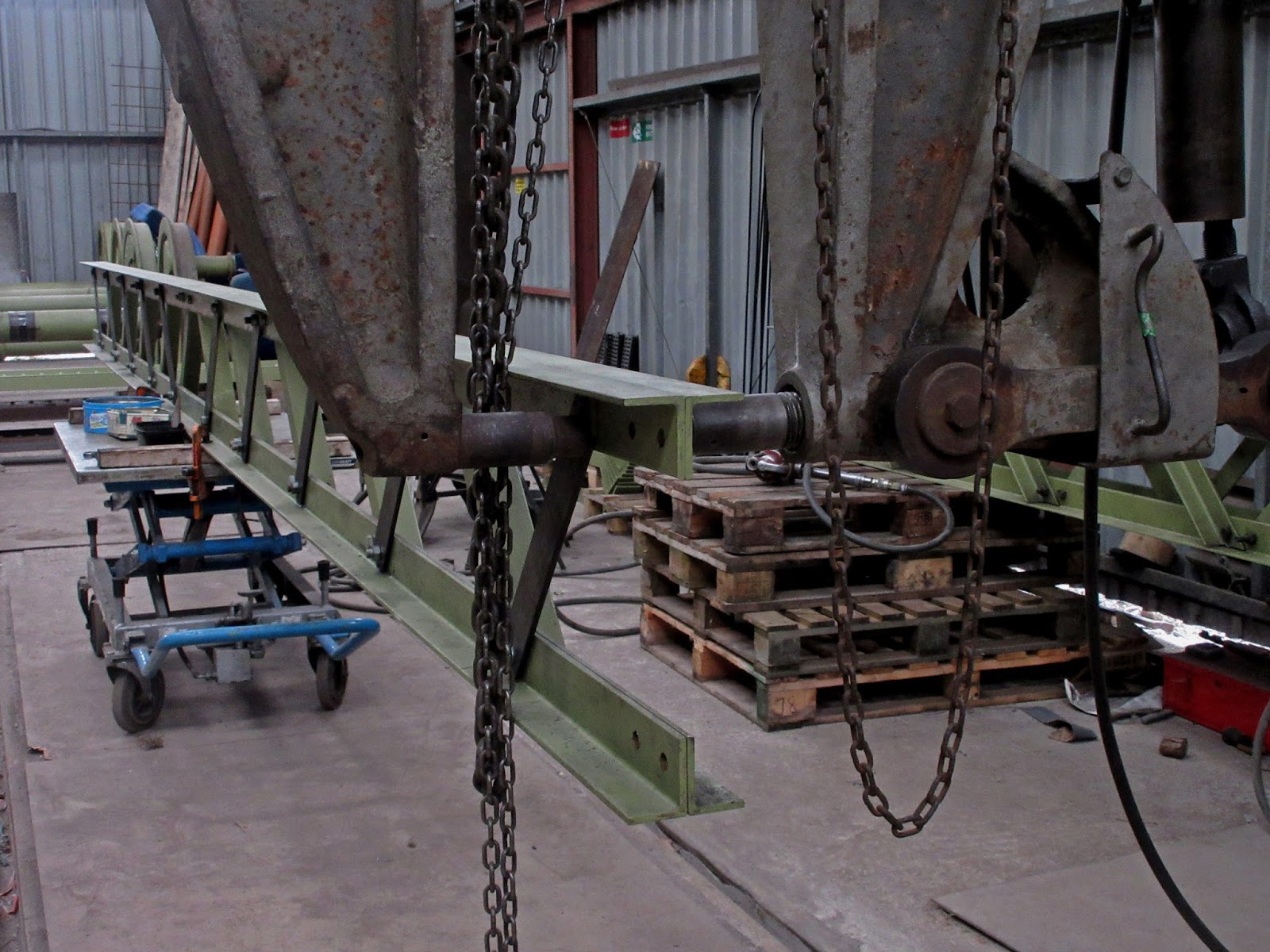
This is the beastie, a big horseshoe shaped device suspended from above. The attachment point is so calculated that it can easily be swivelled to rotate through 90 degrees and approach from the side. The hot rivet is compressed using the air cylinder on the side - this runs off the loco shed's system.


The rivet is heated to a red hot temperature until it sparkles.


A gas burner was used today, as we only did the one rivet for demonstration purposes.


Once the rivet is red hot, an agreed ballet takes place whereby the man on the gas burner steps smartly over to the operating lever on the riveter, being careful not to cross the path of his mate, who is holding the hot rivet to be inserted into the hole without undue delay.

You can see how this is done in the following video:
https://youtu.be/esLbxlrQ4V0

After a pause to let the rivet cool a bit, the riveter is released again with a big rush of air.


Making good use of the sunshine today, after yesterday's washout rather hampered the planned assembly work, the team of two continued on the manufacture of the four remaining trusses (out of a total of 7). Here are three of them outside the workshop, with work well advanced. Before doing any assembly work, a kit of parts has to be prepared first. This stage is already complete.


With the good weather today, work could advance on the first of the next batch of trusses.

One from the first batch of three has been put on trestles outside, and the next one to be assembled has been laid over the top.


A number of lengths of angle have been cut to size in the workshop and the ends bent to the correct shape, after being heated. Here one of the sides of the new truss has been carried over, and is being levered into its place using an offcut.

It is then tapped along until it is in exactly the right place, then clamped down.


Here the other end of it is tacked welded into position.

Once all the pieces have been tacked together, they are drilled and bolted togther with temporay bolts. The final process then is to remove the bolts one by one, and to replace them with rivets.


The intermediate struts have already been cut to size, but often need a bit of fettling at the assembly stage to get them to fit perfectly.


And then they do ! This one is ready to be tacked into place.

Here you can see how one truss piggy backs another, to ensure that it is assembled to exactly the same size and shape. A strut at the other end is just being tack welded.


In this overview, the new truss is almost complete. All the holes then have to be drilled for the bolts and then rivets.

The intermediate, arched purlins are being made by an outside contractor. We have the capability to do this, but chose the contractor as this saves time.

The steelwork could be finished in a month - don't quote the blog on this, things can get in the way - and then a trial assembly will be done in the car park. Next to testing the structure, the prior assembly also allows you to drill the final holes that will be needed when it all fits togther on its frame at Broadway.


All this is being supported by the share issue. It should look fabulous, and will be something we will be proud of and look back on with pride in future years.

Saturday, 18 March 2017

Stressing: get ready - set.....

A challenge was thrown down by the Wedenesday gang: can you finish off the preparations, so that everything is ready for the stressing team next week?
The glove (or was it the broom?) was picked up by the Saturday gang today. Thirteen of us hit the one kilometre stretch and levered, brushed and inserted all day long.

The brushing gang split into two, and headed both north and south of the pulling point. All the extracted clips lie on the sleeper ends.


Here is the pulling point again, now stripped of its special bridging fishplates.

This is where the action will be on Wednesday next week. The rail will be tensioned according to calculations made, welded up, and initially completely clipped up for 40 metres on each side. That will fix the stressed rail, and on a subsequent date all the other clips, about 2000 of them, will be hammered home.


On the northern side, a gang of two on brushes finished the last 11 panels not completed earlier this week.

We then finished the unclipping here, also partially done on Wednesday.

This picture shows you why the brushes are needed. The regulator removed all the excess ballast and put it on the shoulders, but little piles of spare ballast remain just where you don't want them, on top of the hoops in the sleepers. From here they will creep underneath the rail when you lift it, and the rail won't seat properly when you drop it down again.


Brushes come in two sizes - Junior, and Excecutive. If you're new to the team, you get 'Junior'. And like it. Upgrades on merit only, you need a good 'track record'.


Handling specialist equipment like rail brushes is not for everyone, you have to have shown a natural inclination for the art.

Some people never learn, others relapse when close to the expiry date of their certificate.

This member of the gang clearly needs additional training. Time to go home and read up on the manual too, which is the business end again?


This was our target for the day, the anchor point, both north and south. To the left rails unclipped, to the right, 5 panels of fully secured rail. That won't budge when you pull on it.

Admittedly somewhat to our amazement, we seemed to absolutely shoot ahead (it is true, this team of 13 was bigger than Wednesday's team of 9) and towards the end of the morning the southern gang reached their anchor point, all rails on rollers too. They then wandered over to the northern section, here near Laverton bridge on a thick bed of ballast. After a pleasant sunny morning, the sky became increasingly threatening in the background.


With the northern team still brushing and unclipping in the distance, the southern team came to their aid and started lifting the track to insert the rollers.


In this way, it wasn't long before the objective for the day was reached - the northern anchor point for the first kilometre. Here the whole team is seen lifting, brushing and unclipping all at once. Neil is astride the rail, with ballast not yet brushed off behind him, and clean rail in front.
We then repaired back to Winchcombe for a hot meal, today prepared by two chefs at once. Paul and Jim did the honours, and very happy we were with the result too.

With this kilometre now ready for stressing, what else could we do? Well, there is the next kilometre (and there will be a third one after that too) so we came out again after lunch and started brushing from the next pulling point.

Here it is. This one is just south of the next bridge, Little Buckland. Once again you can see the bridging fishplates, and the inscriptions for the distances to the anchor points. It's 493m to the next one south here.


The pulling point at Little Buckland is surrounded by thick ballast. It looks as if the regulator stopped here, as the track is clean in the bottom LH corner. The next stretch is not yet done.

In any case, we can sweep here, but not unclip, as the extension train is ahead of us and needs to be retrieved before we make the track (temporarily) unuseable.


As we scratch our heads over the presumed movements of the regulator, a well known Renault screeches to a halt and disgorges a posse of men armed with brooms.

They slowly work their way south towards the previous anchor point, at the other end of this curve. We brushed 11 of the 30 odd panels on this section, which is a good start.

On Wednesday next week it's all hands on deck for stressing, and in particular for clipping up as much as possible. Your blog will be there!

We haven't forgotten track laying of course, we just need to get this stressing action done, then thoughts can turn back to extending further northwards. We need to empty both the rail bearing flats as well as the 170 odd sleepers that are still on the train, then move it all over the newly stressed section southwards for reloading.

More ballast has been ordered for the Dogfish next week, and a further shipment of rails has been bought, thanks to the ongoing success of the share issue. Two more lorry loads will arrive at the end of next month.

It is wonderful to see that our share issue has almost reached its target, but please don't stop there. Remember that we now have to pay for the £400.000 - odd embankment repair at Broadway. Only a much smaller cost for this was expected when the prospectus was written.

Other news:
The growing pile of components for the Broaday canopy now occupies almost a whole road in the loco shed. The painting marquee has been removed again, so painting of the fascia boards is now taking place at the point of manufacture.


Riveting continues. The items such as purlins and fascia boards are all assembled initially using bolts, and once there is a big enough batch the bolts are removed and replaced with proper rivets.

It might be possible to film this - fingers crossed!


Outside the loco shed, big eight coach trains were chugging by. Here Foremarke hall slowly pulls out a packed train of race goers from platform 1 at Toddington. The placing of the lamps left and right  indicates an express passenger train. (a bit of poetic licence at 25mph, but we like it)

Platform 2 was occupied by an equally long and packed train of happy punters, here hauled by P&O, our big Pacific. It left a quarter of an hour later. The car park was bursting, with many coaches gingerly manoeuvering about, having discharged their passengers from all points of the compass.

Looking at the windows of the train as it passed, we saw that our guys on board had done their job well - every table was laden with Champagne or Guinness. Happy faces all round, it's good to see what a success this is.

Wednesday, 15 March 2017

Getting ready for stressing

The stressing team is coming a week today! It's all hands on deck now to get the rail ready for this. We've got one kilometer of track to prepare.


First, the specialist tools of the trade.

Bars on the left, and yes, brooms on the right. That's right, household brooms. The Saturday gang brought 4 new brooms ( a new broom sweeps clean, after all) and today we bought two more, thus increasing our sweeping capacity by 50%.  No expense is spared, and hang the budget, we have a job to do.
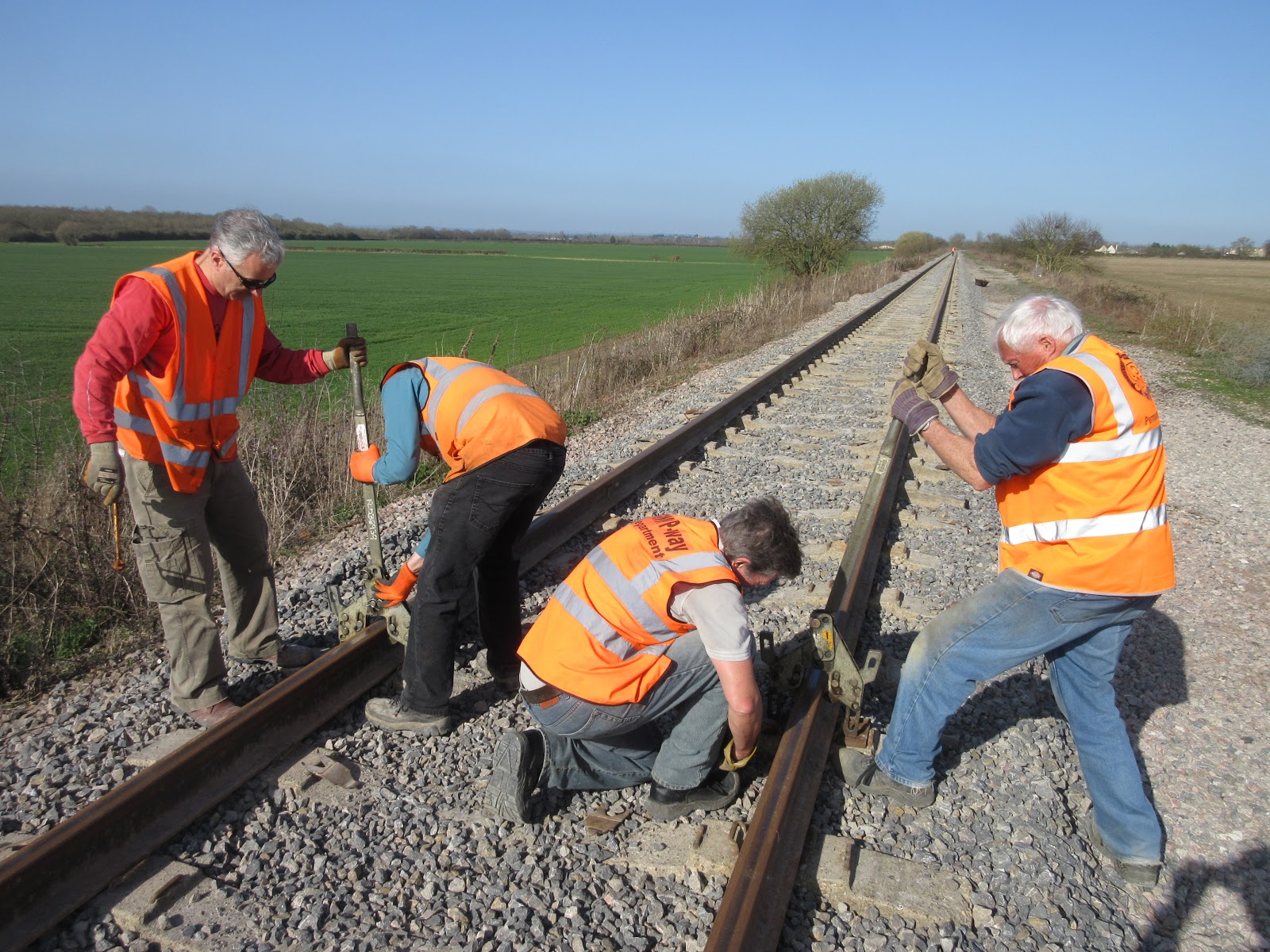


You're probably wondering, why do we need brooms if we had the ballast regulator round?

The answer is that the ballast regulator swept the track very well, but stones remain in the web of the rail, and when we lift the rail for stressing, we cannot allow any stones to fall back underneath it. So the area round the clips has to be squeaky clean of any ballast.

Because of the race trains this week, many of our volunteers are helping on this essential service, and it left a much reduced team on the Wednesday gang today - we were only 9. Here is the sweeping team, setting off from the first stressing point at Laverton bridge and brushing southwards. It feels a bit like curling, with busy sweepers left and right. The gang of six successfully reached the anchor point half a kilometer away in the distance.

Here is the actual stressing point, just next to the bridge. The notes in the yellow flashes say 546 and 547 meters to the anchor. This then is the middle, and the two rail ends will be pulled together to close the gap that you can see. Everything is nice and clean here. 546m left and right are the anchor points against which this is pulled, two sections of 5 fully clipped up track panels. When the pull has been done, the gap will be welded shut and the first 40 meters on each side quickly clipped up to hold everything in place. Then the rest has to be clipped up as well, with rubber pads and the little orange 'biscuits' on the rails. That's a major excercise in manual labour.

While the brushing teamheaded south, an unclipping team of two headed north. When the track was first laid, the rail was held down temporarily by alternate clips. This allowed ballast trains, the regulator and the tamper to pass. Now all these clips have to be removed again, so that the rail can be lifted and rollers placed underneath.

The northern anchor point is a bit short of the start of the curve here. Robert is nearly there, isn't he?


That's because the picture was taken with a zoom lens...

Here is the same picture on a wide angle, and he's still got miles to go!

In fact we had 30 panels to unclip going north, and today we managed 19 of them, so 11 to go. A shorter section was unclipped on the southern side, as the team had to do the brushing first.


Someone else going full tilt for Broadway.
The brushing was repetitive, and the unclipping challenging for the back, having to bend down for every clip. We were glad when the signal was given to return to the mess coach for a gourmet meal prepared by Paul, while we were hard at work.

What's this - foreign food? Spaghetti and meatballs, with garlic bread. Peaches for afters, then a biscuit and a mug of strong tea. Plates were scraped clean, then there was a hush as we contemplated our 'food babies'. Now back to work. What? Really?


Back at Laverton, we were faced with a plentiful supply of these. They are the rollers that have to be inserted under the rail, so that it can move along when it is stressed. They go in on every 8th sleeper.


A start was made in placing the rollers on the northern section. There were two 2 man teams.

One man places a lifter on top of the rail, a jaw with a lever on it that, when pushed down, lifts the rail just enough to push the roller underneath. You then let go again, and the rail comes back down and sits on the roller.


Here Peter works the lifter (a fiendish contraption which tries to cut off your fingers when you lift it into the Landie) while Lee pushes a roller under.

Do not insert a finger to check that it is in the right place!


No doubt aware that we were a bit short staffed today, a further volunteer arrived to offer his services.

Given the brush off for not wearing a high viz vest, he turns away in disappointment. He was next seen serving champagne on a race train, so somebody appreciated his skills.


And then we get those things sent to try us. You'd think that after placing thousands of these clips, volunteers must know which way round they go. But not this way round.

Another example of Murphy's law - if it can go in the wrong way round, eventually someone will do it.


At the end of the afternoon, we had all gained a lot of colour in the splendid sunshine today. There was even talk of shorts next time. We felt we had made great strides forward in the preparation for the clipping, but there is at least another day's work here, or even two. One more week to go!


At Broadway, we can report that the excavation of the horse dock headshunt was successfully completed on Friday.

Because of the greyness of the ash, the picture doesn't really do it justice. However, we have revealed 50 yards of the original 100 yard siding that led to the horse dock, now buried under the platform extension on the right. The slope from the top is now back to its original uniform gardient, and the spoil once tipped here, demolition rubble from the station, and clay excavated from the new platform footings, have all been shuttled down to the future car park.

This shot better shows what we have revealed. Passengers photographing the engine running round from the platform end would see a turnout and two signals here, and two 20ft containers for a maintenance facility.

The ballast levels here have now been determined, and we are ready to start bringing the ballast in.
Before we start track laying here however, we will complete the section from Peasebrook Farm to Childswickham Road bridge first. This will resume as soon as we have finished stressing the section already completed.


Saturday, 11 March 2017

Sleeper laying kicks off again

The running season has restarted, and so has sleeper laying on the Broadway extension! It's good to be working out along the line again.

A good team of 13 set out today, with four to start brushing the CWR section to give it a final clean, ready for the stressing later this month.  More needs to be done here, before the rollers go under.

The other 9 worked on the railhead itself. This is the view off the end bogie flat of the PWay train parked on the railhead. The next point of note is Peasebrook Farm bridge (Bridge 4), just visible by its two sets of handrails. The newly laid ballast bed now stretches off into the distance right up to Childswickham Road bridge, just before the red goods shed visible at the back.


The extension train has been reloaded and parked close to the railhead. We've got 320 freshly loaded concrete sleepers up there, plus enough rail to get us over the next bridge.

The tamper's been right up to the end of the supply train, as has the ballast regulator.


This was the view on Friday, when we ran the two 6T dumpers down here to bring another two loads of ballast to beef up some low spots identified, and to take away some rubbish from the lineside.


And then we were off, with a small but perfectly formed sleeper laying team. The weather was kind, and as you can see, we were soon taking off our winter coats as we warmed up with the physical excercise.


Ade set out the all important blue line to follow, and here Paul is explaining where Broadway lies - it's thataway, about another kilometer further.


Ade then set out some intermediary posts, helped by signs given by the sleeper laying team: left a bit, right a bit, that's it. We need to hit that bridge in the right spot.


After rearranging 8 sleepers left by the lineside by the welding team, we ploughed on with new sleepers and were soon moving ahead of the supply wagons towards the bridge, our target for the day.

Alan brought up a steady stream of sleepers to lay off the two bogie flats, one of which was cleared but for a dozen or so in a corner by the end of our session. This morning's effort already looks quite good, in the foreground.

Then, at a late lunch time, Steve lifted in the final 4 sleepers at Peasebrook Farm underbridge. That made 150 sleepers laid in this session. We could have done more, but had to return to Winchcombe to load supplies and tools into a 10T goods van, which we hope will accompany our mess coach, finally, into a PWay train at the railhead. We are in fact spending a long time getting to the work site after first loading tools etc at Winchcombe, and having to return for lunch and then coming out again. Messing facilities on site, here a mile from the nearest road, will benefit us all. When it rains, there is no shelter at all out here. It can be grim.

Feeling rather triumphant today, we lined up on the final sleeper for a group photograph:

Can you see me, Mum?

Part of the glory also goes to Alan on the Telehandler (already returning to Winchcombe) and to Nigel and the brushing gang, who were working further back on the section that is about to be stressed.

It's worth repeating at this point that your contributions are paying for the contractor lifting in the sleepers, for the sleepers themselves, the layer of ballast on which we are placing them, and finally, the underbridge here, which was refurbished as part of the 'Bridges to Broadway' programme. You made it possible - give us the means, and we will build it!

Back at Winchcombe, this is what we all hope to see on the extension in a year's time - a double header with Dinmore Manor and Foremarke Hall, on a well filled train. The DMU  also looked busy, and it was cheering to see that the season seemed to be off to a good start.