Tuesday, 16 August 2016

Ballasting the headshunt

Things are definitely stirring now on the Broadway extension.

The Laverton loop has been completely removed, and both turnouts replaced, with the northern one still waiting for the replacement rail. Now attention is being focused on the old headshunt, and indeed also on extending the track beyond the current railhead. Things are really moving again now.

Your blogger played a small part in all this today, driving the 6T dumper from the store of ballast at Little Buckland, down to the bed of the former headshunt, which is now being provided with Terram and new ballast. Here is the first load of the day.


The half mile journey with 6T of dusty ballast takes us over Little Buckland Bridge (bridge 5, the subject of radical repairs a while back).

What strikes the eye straight away is that the line of concrete sleepers has been advanced from the rail head near the bogie flats in the distance right up to Little Buckland bridge, about a 7 length zoom forward. This now awaits the new rail.


Here on the GWSR we are lucky in that we have a double trackbed, with only a single track on it, so we can drive down the other side. But it ain't half bumpy! The only way to travel is standing up. To see, to cushion the relentless blows from below (there is no suspension), and to look over the top of the numerous dust clouds that arise when the whole load gets shaken in the wind.

What we see here is the start of new rail laid earlier in the year, the trackbed of the temporary headshunt (in green), Steve clearing said greenery and levelling the bed, and a start in the distance with the new ballast.


In this close up, Steve is shifting piles of dirty ballast and levelling what is behind.

It took him all day, but Steve has now completed this job, and it's ready for the Terram.


Back at Little Buckland, fresh supplies are brought in by lorry, a whole fleet of them.

This is what your money is paying for, dear supporter. Thank you to those who have already helped, and 'please help' to those that are still thinking about it. We need a lot more fresh ballast like this, but you are getting a quality railway for it.


At one point during the morning, it was like Piccadilly Circus, with lorries coming and going and beeping, while the dumper was being loaded by the little 360 with crashes and clatters.


After a brief lunch, in the only piece of shade, which was on top of the dusty ballast pile next to the 360, Steve was reaching the end of the 300yard or so stretch of the old headshunt. The Terram in the middle distance is rolled out piece by piece, and piles of ballast are dumped upon it. Later they are levelled.

6T (one load) seem to go about 3yds, so you can work out a lot from that.

Way back you can see the DMU that has reached the stop board in its shuttle from Toddington.


On the return journey, you cross the bogie flats that are now empty of concrete sleepers.

The new line of sleepers, laid only a few days ago, now extends to the telegraph pole, which marks the position of Little Buckland bridge.


Returning with another full load, one of 25 transported today, or 150 tons by dumper, we find that Steve has turned his attention to pushing out the piles of ballast recently deposited. That suddenly makes it look much more like a railway line. And much longer looking.

Looking north, we can see the results of Steve's labours today, a freshly cleared former headshunt. Beyond, the start of the new track laid earlier this year. We need to meet up with this, then we can move on beyond Little Buckland and on to Peasebrook farm.

Dan, the 360 operator, had a go on the 25th and final dump. It looks quite impressive from ground level, that's a lot of stone being shifted. Behind him, we need a lot more of the same.

In this telephoto shot, the bit still left to be done doesn't look too bad, but it could be another 3 days work. The camera can lie...

What's next?

As you will have read, there are two shipments of new rail coming in, during the first fortnight of September. We need to avoid double handling these lengths.

The first shipment will be used to replace the headshunt track, so it's imperative that the ballasting is completed, and the sleepers, laid to one side, returned to their positions. The rail goes in, the track now extends back to just short of Little Buckland, and the bogie flats, now empty, can be recovered. These can then be filled with further concrete sleepers that we have in store.

Relaying the headshunt with fresh rail not only allows you to recover the two wagons for further loading, but you will then have used up most (all?) of the first shipment of new rail. This releases the two flats used for storing the rail for the second shipment, only 10 days later. They have to be available to stand on the unloading road in order to allow the lorries bringing the rail to unload. Hence the urgency also of the works outside Toddington shed.

From mid September, we would be in a position to commence track laying beyond Little Buckland. The Terram and ballast are already down for that portion, so it could go quite quickly. In the meantime there are various holidays, so if there's a gap, that's why!


Monday, 8 August 2016

More removals at Laverton

A quick visit today to see the state of play. The Saturday PWay gang have taken out all the remaining rail now, so that nothing more needs to be taken out to be replaced.

The two and a half remaining lengths over the bridge are out, as is the northern Laverton loop turnout. A bare bed remains; this needs to be filled with concrete sleepers and new rail.


The turnout is quite large, and its removal left this not inconsiderable gap.

The pile of sleepers was positioned there earlier, with precisely the purpose of filling this gap. Part of the first shipment of rails in September will go in here.


Looking north, you can see that the fresh ballast soon peters out, after which the temporary head shunt was laid on the bare trackbed. A first load of sleepers has already been removed from here and stacked nearby.

The length that needs relaying extends approximately to the bushes on the left. All the available second hand rail from Laverton has now been removed, with the final lengths taken up to Broadway by the contractor today.

Another day of sleeper removal is due to take place here, and then the process of rebuilding the headshunt can start. It will be done in three chunks, in order to avoid double handling of the sleepers - they will go out of the second third, straight back into the first, prepared beforehand, and so on. The area of the former northern turnout will also be graded to the correct height to accept the plain track sleepers.


Friday, 5 August 2016

Rail removal at Laverton

All the remaining clips on the 20 length headshunt at Laverton have now been removed, and the rail tipped out.
Today Steve took out pairs of rails and dragged them up to Broadway for further use there in due course. In this picture you can see the end of the northern turnout, with the first pairs of rails of the old headshunt removed. The JCB is returning from Broadway in the distance.

After quite a few shuttles up and down over 2 days, almost all of the headshunt rail has now been dragged up north.

Here Steve is attaching the last pair of rails to go.

The headshunt section is now ready for removal of the concrete sleepers. These will be stacked nearby, the trackbed graded, Terram and new ballast added, and the sleepers, together with new rail, relaid back in their places. Plenty for the PWay gangs to be getting on with.

Here you can see Steve just passing over the road bridge at Laverton, with a pair of rails from the old loop in tow.
The 2 and a half lengths between the bridge and the turnout in the picture still need the rail replacing, and then the turnout can be disassembled and also taken up to Broadway.

New rail for all this is arriving in two lots in the first half of September. After that has been laid - and it needs to be laid quick, as we need the bogie flats for the next delivery - then the push towards Peasebrook Farm can begin.

This is how the rail is taken up to Broadway. It's basic, but very economical, and it works. The pointwork may need a trailer to take it up.

Broadway canopy construction

Little by little this is becoming an attractive reality. Over three weeks, three trusses have been assembled. Excellent progress!


The first two are in a pile, one on top of the other, in the loco workshops at Toddington. Our Broadway painters have been down to inspect the extent of the work required from them.

Nearby, a fascia board was being made up.


Outside the loco workshops, the third of the seven trusses was being assembled.

Underneath are two more fascia boards. Three purlins are in the loco shed

It will be very interesting to see what the central arches will look like, with their characteristic curves. None have been started yet; they will be done last.

Note that the car park is full, and should translate into fare paying passengers. The trains certainly looked well used - well, it was P&O in charge - and so was the cafe in Winchcombe, always popular.


With Mrs. Blogger stationmaster at Winchcombe today, a quick trip was made down there to say Hello and enjoy a cup of coffee in the Coffeepot.
P&O trundled in, and what a magnificent sight that makes too. Winchcombe, with its cafe and passing place for trains, is a great place for people to linger.


This magnificent main line loco pauses to allow the DMU to arrive, get the token, clang the signals, great 'business' about the station.

Then, off she goes past the bracket signal by the C&W shed. Great stuff !


Finally, this flew over Winchcombe today:


Strange how those propellers rotating at speed give the impression there is a segment missing.

Is this one of the new A400s?


Wednesday, 27 July 2016

Back to the future

Work has resumed on the extension, and in particular on the remains of Laverton loop, and its lengthy northern headshunt. The PWay Saturday gang made a good start with removing fish plates and de-clipping the rails, while the Wednesday gang today had a session after lunch, leaving a small party to continue the relay of road No.6 outside the shed at Toddington.

Here is the northern end of the headshunt at Laverton, not yet replaced with plain rail. Just south of it there are still 3 lengths to exchange over the road bride, then the turnout, and then further northwards over the old headshunt. This is of insufficient quality and is being replaced with new rail, and new ballast underneath.

The Wednesday gang  (or part thereof) can be seen declipping the rail - which is shiny, as it has had ballast trains over it for the newly laid section further up, and more recently to place two sleeper bogie flats near Little Buckland.

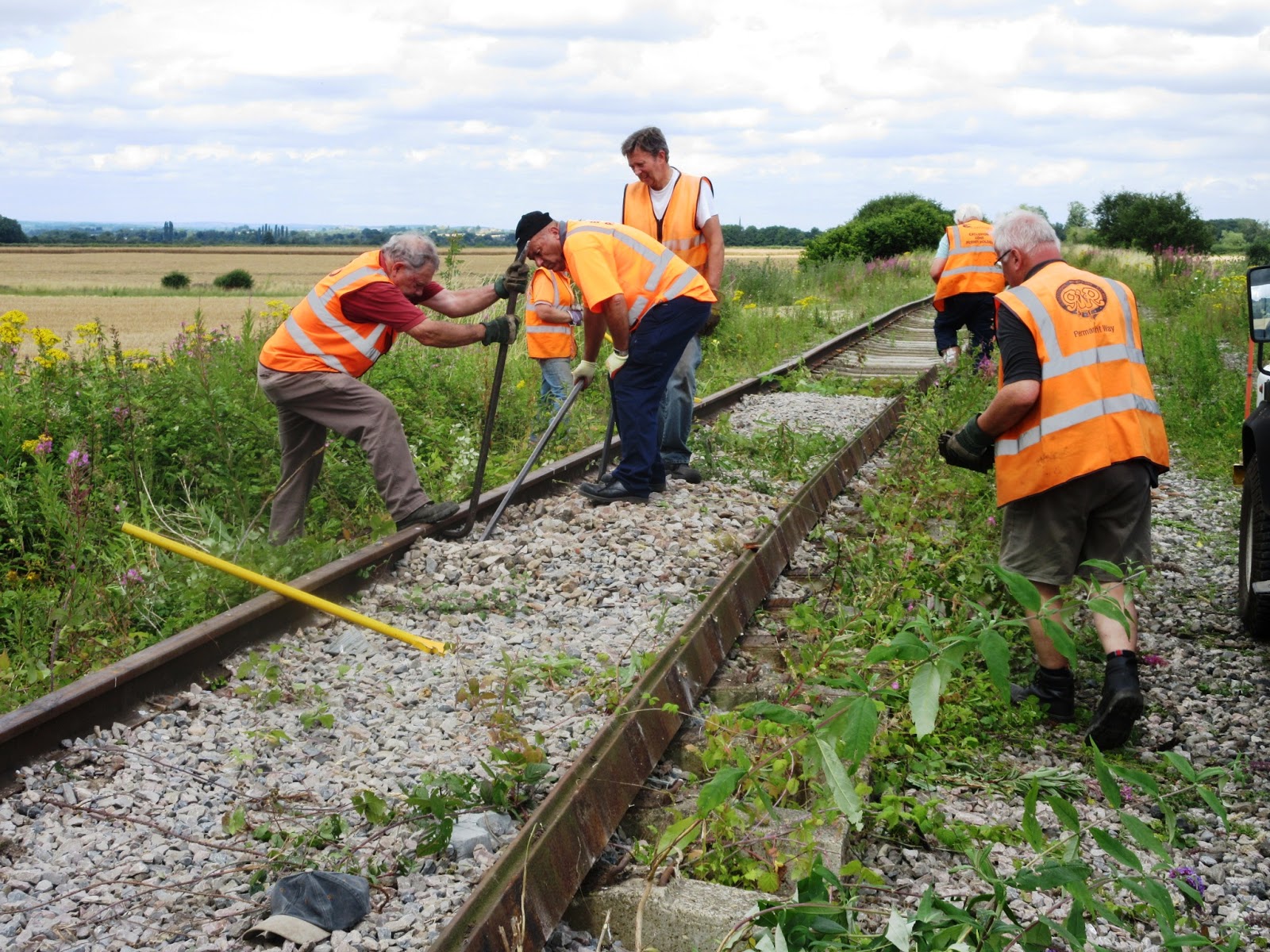
The work involves prising loose the SHC clips, then tipping out the rail. Martin and Lee are having a good go at it. It's repetitive work, as you see the rail still left to do vanish into the distance. We did 5 lengths this afternoon, not bad for half a day and ice cream afterwards as a treat; it was hot again.

The faithful Landie is always present, as an unmissable base for bringing the tools, and taking away the parts we don't want to lose by leaving them lying around. In the centre we can see John trying to get a grip on one of the SHC plates. They need an almighty heave with a large crowbar.

Should your crowbar come adrift while you are giving it that almighty heave, there is always a willing volunteer to catch you from behind. Well, that was his side of the story anyway. From the smile on his face it  looks from here as if Robert has just found John's wallet.


Once all the clips have been removed, inside and out, it's all hands to the crowbars and with another almighty heave, the length of rail is tipped out. It weighs just about a ton.


Now for the other side, or is it?

One small clip is gallantly resisting efforts to tip out the rail, by hiding under the ballast.

Special surgery is required from John, who this time does not have Robert to support him from behind, but rather an unfriendly bed of nettles.


Then, success ! This rail too is tipped out into the four foot, ready for collection.

This rail is not particularly bad, just slightly non-standard, so it is being taken up for use in the layout at Broadway. Once the rail is gone, the old headshunt will be re-graded and relaid with new rail. The new rail, enough for this section up to where the newly laid extension starts, has now been ordered for delivery after the holidays.


Still left to do - 15 lengths of the former Laverton headshunt, quite a stretch. Hard to believe there's a newly laid section further on out there. We need to meet up with it, with new rail on new ballast, and all welded up. Once this is done, we can move on beyond Little Buckland, and on to Peasebrook Farm. All the extension will then be on new rail, welded up.

Here is where the newly laid section starts, 15 lengths further on. The former headshunt had no ballast under it, just roughly laid on the old trackbed.

At the joint, you can see that the rails have a slightly different profile. The new rail is on the right, and has no holes for fish plates, as it will be welded to the other new rail still to be laid to the left.

A last look back over the old headshunt, back in the direction of the former Laverton loop. The black stripe in the distance is a bogie flat parked at the former start of the loop, inside the stop board where the diesel from Toddington shuttle stops.

Small note at the end: It was striking how many bird droppings were concentrated on the rails on this stretch of the line, many more near Laverton than visible on this sample section. Some smallish bird, in large numbers, has sat here to rest on the rails. What could it be?


Thursday, 21 July 2016

The first truss

At Toddington, the first truss for the Broadway canopy is almost complete.


It's so big, it's a bit awkward to fit on a photograph! We got it, edge on, by standing on a chair.

There will be 7 of these. This one is basically finished, except for a couple of uprights to be fitted in the centre.


The length of angle being held on here with a G clamp is not in fact a part of it, but the first piece of the next one. The first piece will serve a a template. The uprights still to be placed go on the flat piece in the middle, on the RH side of this photograph.


A nice bit of style is the bend fabricated into the pair of angles here. This brings the diagonals in line with the bottom. Neat.


To give you an idea of the size of the truss, here is a picture of the end of the Toddington canopy. The truss runs from the far left to the far right; it's a big piece. There are only 4 of them at Toddington, which gives you an idea of how much longer the new building at Broadway will be, with the extra toilets on the northern end.


The area that is as yet unfinished in the new truss is on the LH side here, where it intersects with the arches running down the length of the building.

These arches will be made last of all.


Extension track work.
The extension track gang is still at work in the yard outside Toddington loco shed. The loading road is back in place, and already occupied by a bogie flat. Work has now started on the other half of this job, the relaying of road No.6, back into the loco shed.
As of today, the route was half dug out, and a start had also been made on the relaying inside with concrete sleepers and a first length of rail. Outside, GWR 4270 was having a warming fire lit. It's your blogger's favourite engine, and he has a share in 4253, which you can see being rebuilt from Barry condition here:
http://www.4253.co.uk/Latest_Progress/
But if it's having a fire lit, where is the smoke? Well, the firelighter forgot the matches.... true story!

There are still a few more working days required in the yard here, before the team can revert back to the extension itself.


All is pretty much ready here, as the contractors have left. The bright patch of ballast in the foreground traces the line of the replaced culvert. A bogie flat with a partial load of concrete sleepers is now stabled at the rail head, and this makes the proximity of the works even clearer.


The new rail has been welded all the way up here. The northern turnout at Laverton still has to be removed and replaced with plain rail though.


In this larger view you can again see the proximity of the rail head.

Looking north towards Broadway, it is clear that one thing still left to do is the replacement of the ballast bed and terram sheet.
The pile of stones on the left was used to line the entrance and exit basins of the culvert replaced here.

This is the entrance to culvert 5A at Little Buckland, showing the stones used to line the approach to catch any silt being brought along by the water, and to prevent scouring. The embankment is fully reinstated and there is a nice new headwall.


On the other side of the road, the French drain is complete, back filled with ballast and equipped with two inspection pits.

The French drain leads to the meeting pace of 3 drains at once, including the stream that flows from Little Buckland through a pond next to the railway.


This picture shows the pond, the three headwalls emptying into a chamber on the upstream side of the embankment, and in the background, the source of all the water: the Cotswolds Edge.

What you can't see is a large number of swallows circling inside the area of the pond, catching the numerous insects hovering there. Very rural.

Thursday, 7 July 2016

More canopy work

At Toddington the construction of the new Broadway replica canopy is making good progress. Since our last visit, a second length of intermediate purlin has been made up.

It is parked on a trolley by the loco disposal pit, ready for the admiring glances from the lucky few behind our largest locomotive, P&O. Note how the purlin is held together by strips on one side, and angle on the other. This second piece was assembled rather more quickly than the first, in only a day and a half. The canopy consists of several identical compartments. Manufacturing the first item always takes a little longer as you gain familiarity with the structure and process, and the second of the series then becomes a lot quicker and easier to make. It is the intention to assemble one complete compartment first, with the exception of the connecting central arch. These will be made last of all.

We now have two fascia board lengths, three rafters and two central purlins.
Back in the loco workshop, construction has started on the truss, the largest piece. The vertical strut on the left is where the middle of the truss will be. The structure has been placed on one of the fascia boards, as the floor in the workshop (the former goods shed) is not sufficiently even.

In the picture below (inverted for comparison purposes) you can see where the truss will fit:

The central arch, to be made later, curves away to the left. At Toddington, the steel canopy rests on stone blocks let into the top of the solid walls, but at Broadway the canopy will sit on a steel frame hidden inside the walls, as we now need a double skin wall for insulation purposes. Notice also how part of the canopy is covered in corrugated iron, and part is glazed, which gives it a very airy feeling.


The E Finch, Chepstow worksplates have now been lettered, and handed over to the builders of the footbridge and canopy.

We were asked if one worksplate should be mounted upside down, but declined, as that was a peculiarity to Toddington!


A last look at the yard in front of the loco shed shows good progress also with the relaying of the unloading road. The turnout is back in, and the unloading road has been reconnected. Aligning, levelling, ballasting and packing are still to follow; also the relaying of No. 6 shed road, where the inside is still being prepared for a final area of concrete floor. We are almost ready to receive an order for more rail.