Tuesday, 9 May 2017

The regulator is back

We have the ballast regulator back to sweep one or two odds and ends, but principally to clear the last 500m of the next section to be stressed. This had extra ballast dropped on it to deal with low spots, and to give more support to the sides.

After dealing with a couple of spots near Laverton, the regulator arrived at Little Buckland to consider the job.


It was decided that a first pass with the ploughs out would be helpful, so these were swung into position, dropped down,  and the regulator then moved off in the direction of Peasebrook Farm, crunching and squealing as it went along.


After returning from Peasebrook, the ploughs were withdrawn again, and the brush box dropped, just north of the bridge.


The regulator then moved slowly north, creating its own little dust cloud. The bed it left behind is already much cleaner, and now just needs some manual sweeping over 500m to get it perfectly clean, ready for lifting.

We will be doing this tomorrow, and inserting the rollers that permit the stressing to take place.


As this next 1000m section is almost entirely on a curve, two sets of rollers will be used. The normal flat rollers go under the rail on every 8th sleeper, and to prevent the rail from moving towards the centre of the curve, additional side rollers are attached to the hoops, as demonstrated here by Steve. All very interesting, it should be quite exciting when they do this next Tuesday. Wednesday then is the big clipping up day.


Steve shows us the special side roller that's used in curves on CWR. It attaches to the hoop on the SHC sleeper.


In other news

Riveting at Toddington continues to do well.


Here they are on one of the 5 ridge purlins. They hope to complete it during the day, and this will see 3 out of the 5 ridge purlins complete. The other two, like the first two, still need some rectification work on the strips before they can be rivetted up. This one has had the strips replaced already.


Outside, the two completd ridge purlins are ready for painting, which may happen tomorrow (Broadway being a bit blocked with the container movements)

On the right is the stack of fascia boards, and on the left some of the other purlins, all riveted.

Some more gusset plates have to be made, before trial assembly can be entertained.


*******

The soil nailing rig at Broadway is ready to go. Other kit was being delivered late last week; the first soil nails are being sunk today.


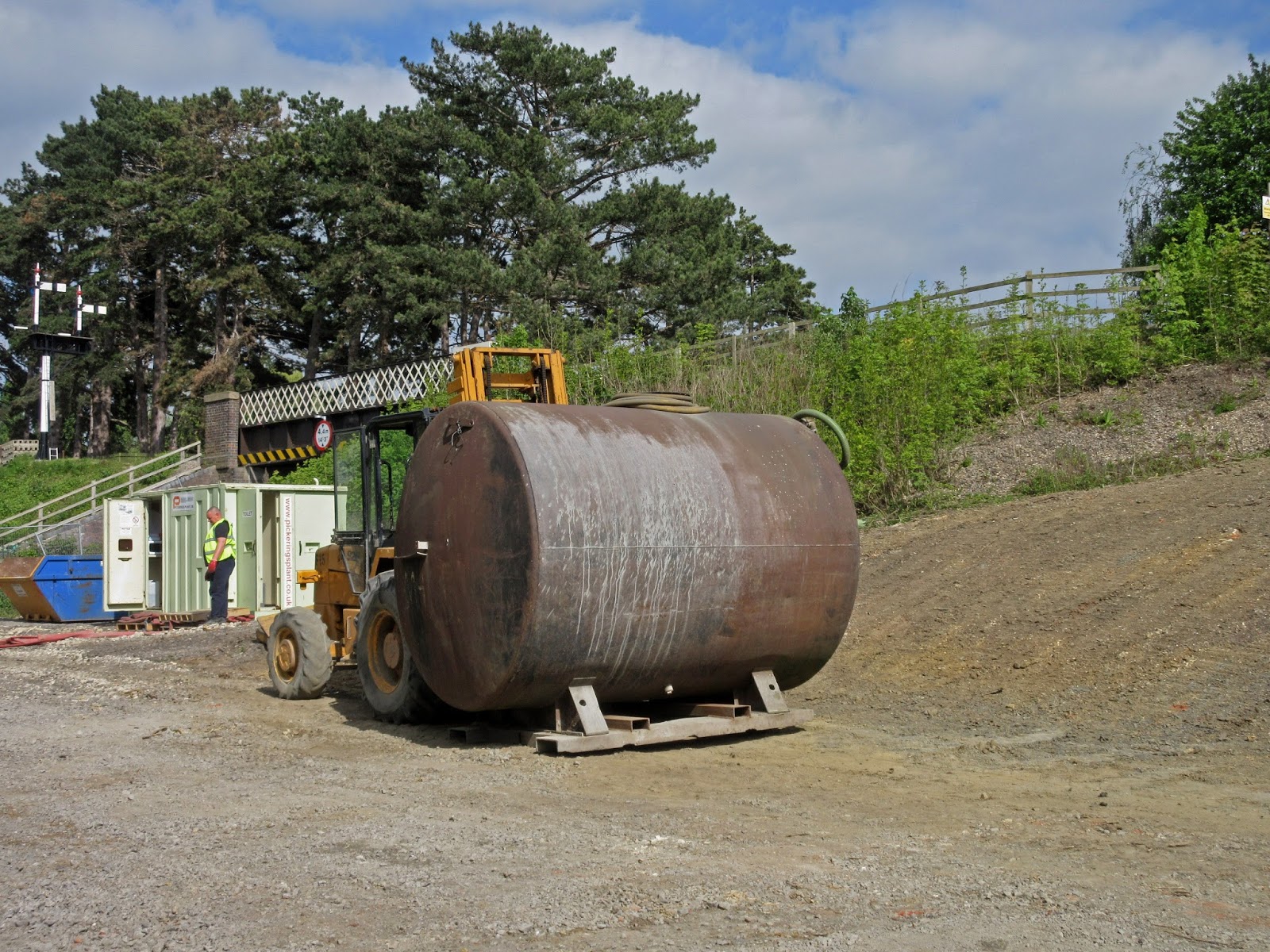
This is the 'water tower' being delivered on a fork lift.

It will be filled with water which will provide the drillers with cement mix that will be injected down the holes.


This morning the drilling rig set off to climb the embankment towards the first hole, located top left, where the worker is standing.

There will be about 500 of these soil nails, spaced 2m appart over a 150m embankment, in several rows. The top row has nails 9m long, the middle 14m and the bottom shorter again.

If the rig starts to climb, won't the rear end overhang jam on the ground?


Aha, the manufacturer (German) has thought of that. You can lift the platform hydraulically, so that it is always horizontal.

And up it went.


Here's a close up of the beastie. It's already fitted with the first rod; a second (silver) lies top left, ready to be fitted. This rig can drill though most types of soil including rock, but obviously things are simpler if the terrain is soft clay like ours, so no great problems are expected.


Arrived at the top, the rig is positioned so that the bit points at the desired hole. It is then drilled down like a big version of your domestic drill, except that here the bit can be lengthend, as in an oil well, by adding additional lengths of pipe.

The drill head and pipe are sacrificial, i.e. they are single use and stay in the ground.


When the first length is in the ground - it didn't take very long in our case - the operation stops, the cage is opened and the next length is inserted, attached to the first by a sleeve. The pipe is hollow, and down it a cement slurry is pumped. This comes out through the drill bit at the bottom, the rises back up the holes outside the pipe, sealing this in cement, and at the same time filling in any fissures or voids around it. You end up with a concrete rod which is a couple of inches in diameter.


The end of the pipe that sticks out of the ground is finished off with a big plate and a cap. Over the whole area a net is pulled, and this unites all the ends of the rods into one unit. Finally, the whole area is hydro seeded.

There's a big box of parts at the bottom - drilling pipes at the front, galvanised pipes that protrude at the surface, wire netting to cover the site.


The site manager was kind enough to show us what a drill bit looks like. There's a bag full of these, and one is fitted to each of the lowest pipes that go in the ground. The cement slurry that is piped in at the top flows down the pipe, and exits at the bottom through the square hole in the middle of the bit. It then flows back up, filling the voids as it rises.


Saturday, 6 May 2017

Clearing the supply train

That was today's objective. We had 160 sleepers still on board, and we need to clear the train so that more can be loaded at Skew Bridge, where 200 are already waiting.

It's a long walk to the supply train at Peasebrook now, starting at little Buckland, especially if you have missed the Landie 'bus'. In the foreground is the northern end of the second section that is about to be stressed. The PWay job is a healthy one, you get plenty of chance for excercise.


When you get to the mess coach, it's another long walk, past the supply train and then on to the railhead.

Here Pete and Mike look at the sleeper stack that we want to clear today. There are 160 sleepers left to do.


Today we had both Telehandler and JCB available at the same time, so sleeper laying proceded apace. Here Alan is bringing a healthy stack of 12, as Steve waits with the boom and chains. Peasebrook Farm and its line of trees are receding into the distance, as the railhead advances.


Pandrol clips have been laid out in bags along the bit we will be doing today (a bit too generous, we haven't enough sleepers on site to get that far) and with the measuring wheel Nigel is off in the direction of Broadway to work out where the breather is going to be situated. It works out at just short of Pry Lane bridge, a bit round the curve in the distance.
On the left is the silo of the sewage works. We are getting closer - some say we are already there, because you can smell it!

Not long after starting off today, we passed the site of the former PWay hut on the right.

If you want to see a photograph of the scene taken in 2012, use this link to the Flickr site with GWSR track walks:
https://www.flickr.com/photos/73536293@N02/6886613513/in/album-72157629372584449/

Unfortunately the old hut was too far gone to be saved, all the vertical sleepers had their ends rotten.


In the remains we found a good collection of cut nails, an old form of making nails.

Mike has a fistful of them, as Bert Ferrule looks on.

Behind is a huge field of rape, which affected one or two of us.


As Broadway slowly gets closer, three of us walked up to the southern fence for the embankment works (see below) and had a look-see.
A little disturbing was the sight of 4 walkers who walked down the same bit half an hour later. There is no trackbed access, unless you climb over a fence. They vanished at Pry Lane bridge and scrambled down the embankment, where once again a fence was climbed.

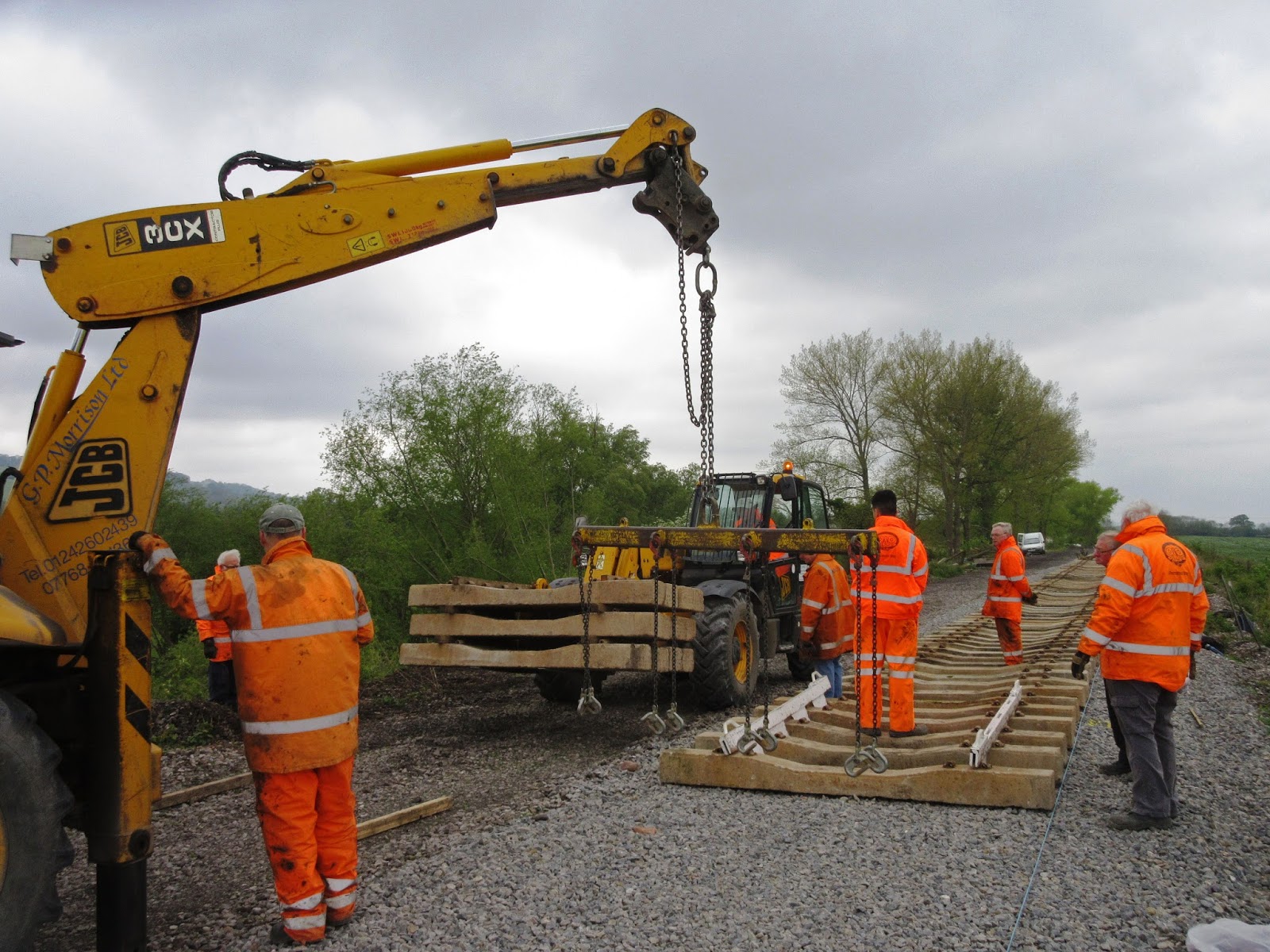
Shortly before lunch, it was decided to split the gang into two again, and use the JCB to start laying in rail. This then leads to a traffic jam in the middle, as Telehandler and JCB wait for each other to pass.
The sleepers are nice and straight here, good work by the laying team. The rails should drop in nice and easy.

There's a 'passing loop' somewhere near the middle of the working area, where the two vehicles can get alongside each other. It's a bit of a squeeze though, and you don't want to get too near the edge, as the embankment is very high here.
The laying team wait patiently (in ice cold wind) for Alan to return with the next supply. As we passed the trees it became abundantly clear what shelter from the wind they had afforded us. Now we are mercilessly exposed all the way to Childswickham on the tall embankment.

When you lay the sleepers with the Telehandler, it has to face the right way. This is the opposite way to when it arrives, so a three point turn is required on the narrow trackbed, with a steep drop on either side. Luckily the Telehandler has a very tight turning circle.


Meanwhile, the rail laying team has gotten into its stride just past the trees. Steve brings up one of the first rails today here.


Then it's 12.30 and time for lunch. The gang starts to drift back towards the mess coach.
In the foreground you can see that the first layer of new rail has already been used, and we are on to the second. A second load of two levels is on the other bogie behind the camera.


When we finally get back to the supply train with the mess coach on the end, we can see that only 20 more sleepers remain to be removed. That means we laid 140 this morning, and the laying gang is well pleased.


Beans, beans, the musical fruit....
Jim has a vast supply of beans for us, as well as crispy chips and a panful of sausages. After we had worked those down our gullets, there were cupcakes baked by Mrs B. These went down exceptionally well with a strong cup of tea.
Steve is (still) on a diet, but felt he as allowed one cupcake. Imagine his 'disappointment' when the cupcake he picked accidentally had a second still attached to it. What could he do but eat that one as well?

A snapshot for blog readers, taken from the Landie 'bus' as we hitched a ride back to the rail head. The rail wagons have been split off from the supply train and pushed further up the newly laid track, to shorten the distance we have to drag the new rail. The last of the Peasebrook Farm trees can be glimpsed on the right. Just visible in the distance is the red former Broadway goods shed.


After lunch we laid the last 20 sleepers, now approaching the sewage farm.

So that's 160 sleepers laid today, and the three sleeper wagons cleared. Job done!


The rail laying team made rapid progress, thanks to the wagons being in a nearer position.

While half of them laid the rails into their beds, the other half straightened up the sleepers, and attached one Pandrol clip in two.

Where the sleeper is a bit low, a special Pandrol lifter is used (on the right here). You can then pull the clip in with a 'Pan Puller'. (centre)


Seen from the deck of the Landie, the rail laying team is busy putting in the first rails today, just past the trees at Peasebrook Farm.
With all the sleepers available now laid, Alan found a useful alternative job for the Telehandler. This is a jumble of rotten fencing material, which is going to a pile below for disposal.


Mid afternoon saw the rail laying gang reach the rail head. Here they are stood to one side out of the way, as another rail is dragged up. Bert Ferrule has a word with Stevie, before changing from chains to Camlock for the final lift into the sleeper beds.

Six pairs of rails were laid today, giving another 110m laid towards Broadway.


At the end of the day the gang members slowly trudge home.

The first bogie flat has been cleared, and the second already started. More new rail is being ordered, thanks to the success of the share issue, which saw enough money raised by you to lay all the track into Broadway, and complete the main station building.Well done (if you became a shareholder anyway), you are part of this success.


Back at Little Buckland, we are looking south at the bridge and the approximate position of the second pulling point. The northern anchor point is about 500m behind the camera, and was recently ballasted again, to make sure it doesn't move when it is stressed round this curve.
Before we can stress this, the rail has to be cleaned and put on rollers, so the ballast regulator has been ordered in to sweep the section in the foreground. Regulating is booked for next week; the stressing and clipping up for the week after. It's all go, we have a deadline to meet, after all.

Other news

A visit to Winchcombe for some bits for Hayles found an impressive pile of signal posts, freshly equipped and painted. Isn't that a lovely red finial on the end of the nearest one, a route indicator signal which will be positioned at Broadway for trains from the Honeybourne diredction.


This fourth signal post is an original wooden one, donated by a BAG member who had it lying across his double garage. It will become the platform 1 starter signal.

No doubt this disposal improved domestic relations no end, and piled on the brownie points. (we hope)


The 4 signal posts are ready to go, and are just awaiting transport arrangements to take them up to Broadway. It looks as if this will happen in about 10 days time, and after that they will be erected asap, as this helps the positioning of certain elements of the track layout. Conversely, they can't be dug in if the track is alread in the way, so all the signs point towards 'go' here.

Also seen at Winchcombe is this 10ft GWR wooden platform bench. We all know the benches (which you can buy as replicas today) with the cast iron ends, but this is one of the rarer all wood ones, which a member was lucky to find. It needs restoration, and a start has just been made by one of the craftsmen in the C&W department, who were very kind to offer to help restore this precious GWR item.

If you look at this very early photograph of Broadway, you can see one of these all wooden benches under the canopy on platform 2. On the right is the horse dock headshunt, which sadly has had a large reinforced concrete raft poured on top of it, for the positioning of two steel containers as a permanent structure.
In the background you can make out the ridge of a roof. This was the first signal box at Broadway, which was used when Broadway was a temporary terminus while the line was further built to Toddington.
In the foreground is evidence of the construction of Broadway in that summer of 1904, and it would seem that the running in board and a number of lamp posts still remain to be put up.

Two recent pictures of the Broadway embankment works will also interest you.


George Law have now completed the earthworks, which consisted of smoothing out the embankment slope to give access to the soil nailers, and levelling the various spoil dumps at the bottom into a flat area which extends about 2/3 of the way back to the Childswickham Road.


Seen from the south, you can see the embankment cleared of vegetation, and a large flat area in the foreground.

It's a good start for our future car park, if and when we can find the money for it.


Yesterday the contractor for the earthworks was clearing up, while the first pieces of machinery for the soil nailers were being delivered.


In this most recent picture, you can see one of the drilling rigs that has just climbed up the slope to the top, by way of a test.
The slope shows numerous caterpillar tracks (as does the flat area in the forground) where the rearranged earth has been tracked in to compact it.

You'll be pleased to hear that while the bottom of the slope was tidied up, the top was left pretty much as it was, so the trackbed of the up line is still there.

Wednesday, 3 May 2017

Stack talk

Our gang today split into two: One to do sleeper stacking at Gotherington skew bridge, the other to lay out rollers for stressing on the extension, and to clip up the track laid on Saturday.
As this news is hot off the press and your blogger can only be in one place at a time, this report is from - Gotherington.

Sleeper stacking then. Although we kick off at 9am at Toddington, we have to drive to the site (wherever it may be that day) and before that, we have to find the kit, get the Telehandler, and find or load the forks. There is always something unexpected to hold you back as well. What would it be today?


Surprise! A railway carriage parked across the access road to our yard. It was cunningly placed just around the corner of the shed, so that you had to drive right up to it before you realised that there was no way past. A queue of volunteers and Telehandler soon formed. Eventually it was hauled away by the 03 shunter.
Tools found, and the stillage for the track gang lifted into the Landie, we finally set off for Gotherington. Not before we were waylaid at the gate by the B&S mob, would we please just do a little lifting for them. Oh alright then.


We found the yard at Skew Bridge scattered with abandoned sleepers, left over from the previous loading session. We tidied these up, then laid out new bearers for the first few stacks.

The target for the day to beat was 80 sleepers extracted from the jumbled pile, sorted and stacked.


We had two Telehandler drivers in our little gang of 3.

Here is Peter, charging at the pile in the hope of netting one or two desirable sleepers.

The other two were on bars, to straighten them up into neat sets of 4, after which they would be stacked in groups of 20.


There is a temporary stacking base by the gate, to which crooked, upside down, unsuitable or broken sleepers are brought. The men with the bars check the quality of the sleepers offered, and make the rest into neat piles of 4. That's hard labour on the bars, those sleepers won't slide along very easily.


While we do this, various trains go by. Here's the DMU heading north, just after pulling away from Gotherington. The trains did not seem very full today, perhaps people have had a surfeit of days off after the bank holiday?

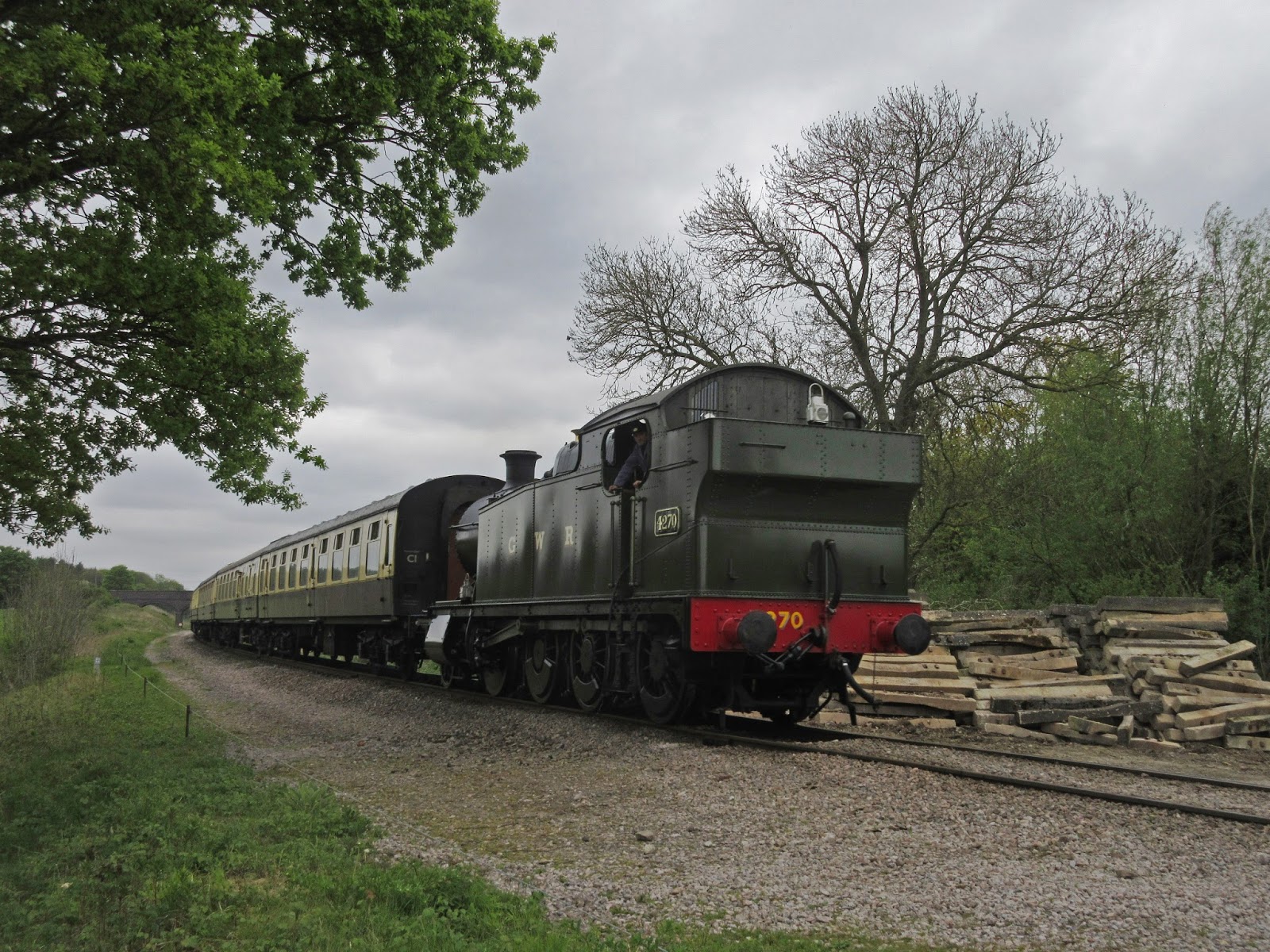
By careful study of the timetable, it is possible to take one or two interesting snapshots of steamers going by. Here's 4270 accelerating out of Gotherington. A word of thanks here to Bob, for moving the Telehandler out of shot a few seconds before 4270 came chugging round the bend. You can still see the wheelmarks! It was a hasty departure, but the result speaks for itself.


It was breezy today, cold if you stood in the wind, and hot if the sun came out.

For our sandwich lunch, we checked the site for wind, and found the shelter of the sleeper pile to be the warmest place.

Peter told us of his trip to Japan, the bullet train and the sight of Mt.Fuji (from a distance of course).


After a short sandwich break, we swapped Telehandler drivers and it was Bob's turn on the forks. Peter has decided to watch the spectacle from a seated position. Bob is trying to extricate a single sleeper at an angle, and with forks that are on two slightly different levels. Tricky. With the cab offset to the left, he can see only one fork at a time, the LH one, so what the RH one is doing is always a bit of a guess.

We warned Bob whenever a train was due, so we see him here paused while the DMU trundles by.

Towards the end of the day, as tiredness began to set in, we received the visit of two more of the gang. They said they were bringing tea and scones, but they lied. It was a load of bearers, recycled from Peasebrook. Damned. Hopes raised, then dashed again.

4270 came by in both directions of course, so here's a shot fom the other side, with the train heading south. The slightly diminished but still sizeable stack of jumbled sleepers is on the right. There's a good few more sleepers in there.

At the end of the day, we had made up these neat stacks, seen here in front of the Telehandler. Bob and Peter are congratulating each other, because we managed - 120 of them. Tiredness began to set in, so we called it a day with this total, with which we were very pleased.

In other news

The riveting of the 7 trusses for the Broadway canopy was completed yesterday.

You can see them stacked at the back here. The trusses alone swallowed some 500 rivets, and to that you can add those in the purlins and the fascia boards. There must be well over 1000 of them, all done individualy by the great horseshoe riveter in the picture. Next on the menu, and last of all, are the ridge purlins supplied by a contractor. One of these is shown set up here. They go in at the apex, in between two trusses.
Glazing and corrugated iron are being discussed at the moment.


On the Broadway embankment, our contractor has continued clearing the slope of vegetation, and making it smooth and accessible for the soil nailers, which are due next week for a period of a month.


The bottom of the slope is being straightened as well, and at the foot a strip of level ground is being created which is 11m wide. All the voids have been filled in up to the trees in the background, and the surface made level.

Cars could park here in a herringbone fashion, but it isn't a formal car park yet, and we don't have planning consent to use it as such. With the limited funds we have, that's a project for another day.


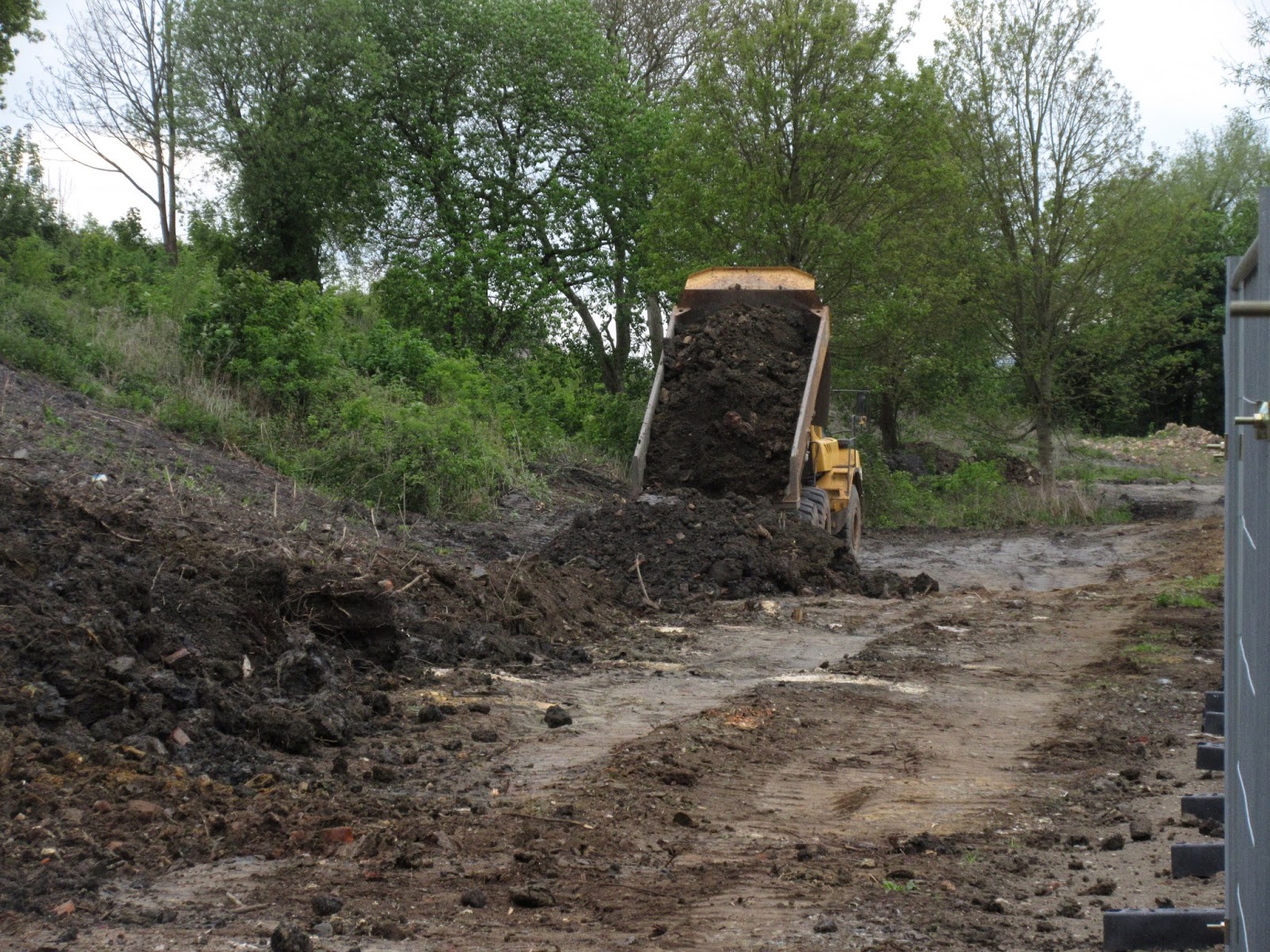
The excess from the middle is being dumped at the rear, by means of the large 25T dumper.