Today the PWay gang split into three teams:
- One to sort out one or two left over snaging issues at Laverton from Saturday
- A second in the yard at Winchcombe to take the chairs off sleepers recovered from the Winchcombe relay
- A third at Gotherington, to sort further concrete sleepers to help make up the next sleeper train.
Your report today is from - Gotherington. Three of us here today, sorting and stacking concrete sleepers.
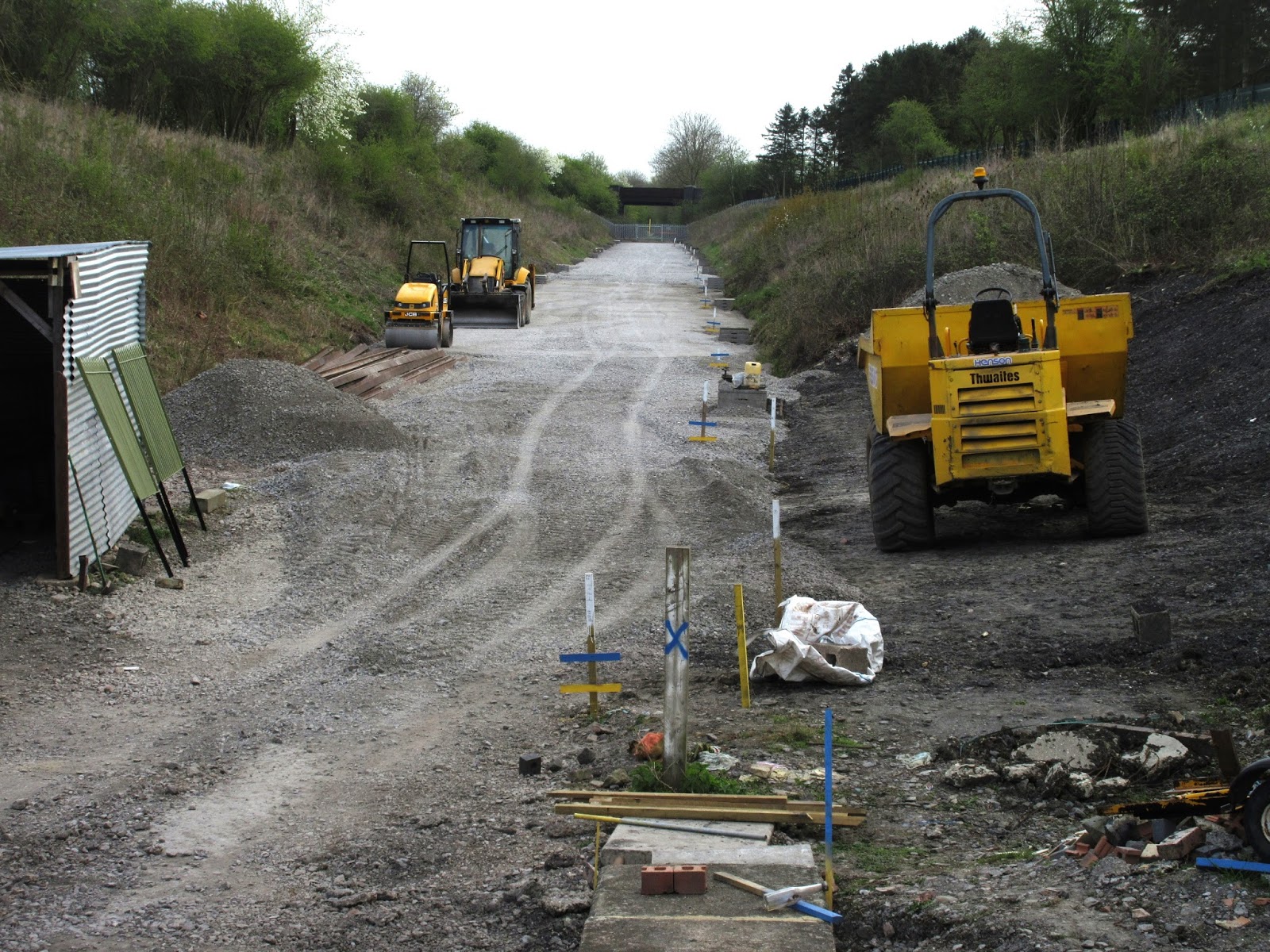
This overview of the little triangular site is from the top of the jumbled sleeper pile, which is now starting to look a bit smaller, and there is a feeling of more room around the site. Logical of course, we have already laid 2km of concrete sleepered track on the extension, with at least another km to go. That takes a lot of concrete sleepers.
Peter volunteered to bring the Telehandler, and arrived with this one. It's not our usual one, looks rather small, wouldn't they give you a real one, Peter? It turns out that this one's a rental; the company one being used at Winchcombe. It did manage 4 sleepers at once, if you didn't boom out too much, so we were OK for the day.
It's not an easy task to pick up sleepers from a pile stacked in a bit of a hurry. They are parallel, but there are no bearers and most are on their sides or upside down. Here is Peter having a bit of a dig at the pile, in the hope of extracting one that will stay on the forks when you reverse away.
Plenty of time to watch trains at this location, they steam right by only a few yards away. Here is 2807 passing the area that will be full up when we have assembled a train load of sleepers, 320 of them. That's several days' stacking though.
To relieve the tedium of stacking one sleeper after another all day long, fate throws in a few curve balls along the way.
Previous stacking teams had left the right hand pile alone, and we soon noticed why - there was a tree stump right in front of it. Peter had a go at removing it, prodding it repeatedly with the forks, then digging in and lifting - out it popped!
Other sleepers came out awkwardly, almost falling off on one side, or threatening to slide along as the Telehandler drove along the slope.
John helped him along with this particularly recalcitrant example. It need just a tiny bit of extra weight at the other end, and so doing we slowly took it home to the preparation base, where we assembled groups of 4. These we then took over to the growing stacks, which are finally loaded on to the train.
The DMU was out today too, but not so busy we thought. Its passenger numbers seem to vary from day to day - we have also seen it pretty full.
On the left are the ready piles, to which Peter will add the four in the centre. We don't manoeuvre when a train is announced. Earlier in the day the Landie brought a huge pile of bearers, on the far left, which had to be picked up from Peasebroook. They go round and round, out with the sleeper train, then back to Gotherington for more stacking.
Here the Telehandler approaches the pile to pick up one of the odder sleepers, lying about. Which one to take? It looks like a giant game of 'pick up sticks'.
Then 2807 returned with another outward bound train. John has the timetable in his pocket, and walks out to spot them coming. Peter has paused on the right.
There's a huge wall of sleepers facing the Telehandler driver. We not only have to pick them out of the pile, but check them for breakages, and sort out those that are of a different size. There are also two styles of attachment - the SHC clips involving hoops on the sleepers, and pandrol clips, which are little pig's tails that slide into a little steel tube on top of the sleeper.
Here's our pile of rejects. Can you see what is wrong with them? They all have a default somewhere.
Towards the end of the afternoon 2807 returns from the Cheltenham end. The partly cloudy day you can see meant that at times it was hot, and then again icy cold, the zips on our jackets were pulled open and shut.
Lunch was on a sleeper in the sun, so we have to admit to quite enjoying our day at Skew Bridge. In the afternoon Bob came to relieve Peter on the machine, and all in all we sorted and stacked 96 sleepers today. That is added to the total of 120 that were already there, done by an earlier gang. that means another 104 are required to make up a train of two bogie flats with 320 sleepers in all, so another day's work here is required.
Next to a steady stream of vintage cars coming down the road, we noticed this pair of biplanes up overhead. What would they be up to?
Broadway North
Steve has been at Broadway for quite a while now. Dumpering ballast has finished now, and at the moment there are two further activities to see.
The Future Maintenance Facility is being built.
Rather than stand the containers on upturned concrete sleepers, it has been decided to construct a 9 inch thick reinforced concrete pad.
This is being constructed here. Shuttering has been put up, and stone is being brought in to lift the base and support the concrete.
Here the stone is being tipped into the shuttering.
This is the view of the Future Maintenance Facility from the end of the platform. A steam loco running round would be seen at the spot where the dumper is here.
We have only a few days left before the embankment by the goods shed is closed off for soil nailing for 3 months. Steve has been busy dragging rail up from Childswickham, and more recently also parts for the first turnout at Broadway north. The parts will come from the former southern turnout at Laverton, and this will now face the other way, and become the northern loop turnout at Broadway.
Wednesday, 12 April 2017
Saturday, 8 April 2017
Track laying today, and snagging
That's pretty much it for today, but what a day. Glorious sunshine out at Laverton, the larks were singing, and the kites flying. One of us was even seen with a tube of sun protection cream.
Isn't this a fabulous view! The PWay mess coach, with its little brother the tool van, on the newly laid track at Laverton. This is the bit that has recently been stressed, but it isn't ready yet. It still needs ballast on the shoulders.
The mess coach was shunted here as it's about the centre of where we are going to work today, in the middle of about a kilometre and a half of new track that needs more work on it.
Tea first, let everyone arrive, then a briefing. We had an unusually long list of tasks today, 15 instead of the usual two or three.
The Landie arrived from Toddington, and then we were off up north.
So, this is what we achieved today, with a team of 12:
Track laying:
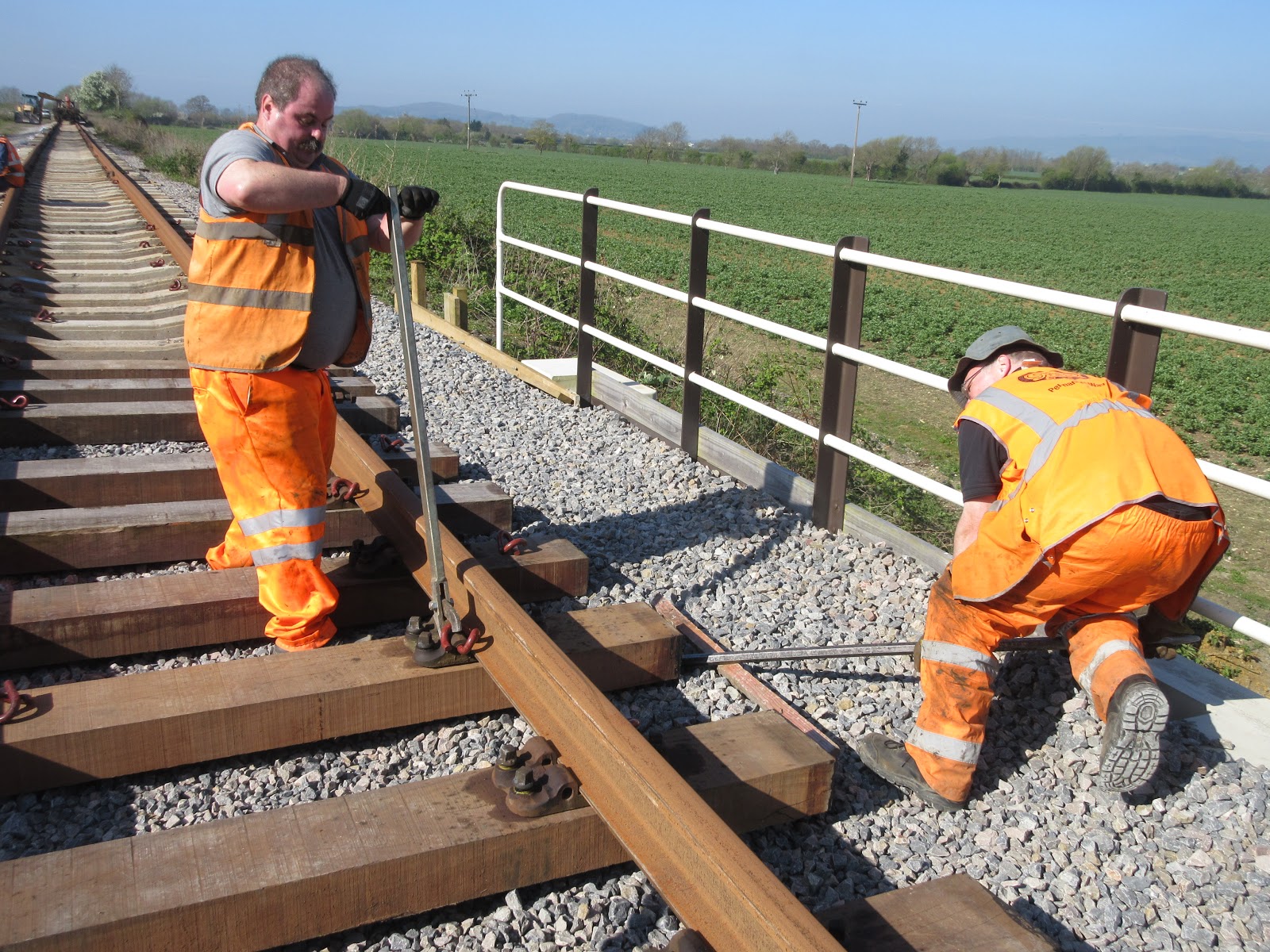
We met Steve in the JCB at Peasebrook Farm, here visible in the background. We split into two teams here. One to fit one Pandrol clip in two to the track we laid last time (when the JCB broke a control rod on the back actor). You can see them at work on the right here.
Hayden is supposed to be unloading here, but is chilling out in the back of the Landie. The youth of today. Tsk! But we couldn't do without their vigour and enthusiasm.
The other team cleared up the remaining dozen or so concrete sleepers off the sleeper wagons, so that they are now ready for loading again at Gotherington.
Here is Steve with a forkful, dropping them off the end. In the foreground the sleepers laid last time, not fitted with rails because of the JCB defect. Broadway is at the back in the early morning mist.
We had 8 rails left on the two bogie flats. They need to go down asap, as a new delivery is due in two weeks.
We put 6 of them on the sleepers, so extending the track by another three lengths.
Here Steve is bringing up the last two lengths - the bogie flats are now ready - objective achieved!
The last two rails were laid in the four foot, ready for next time.
The other team was clipping up with Pandrols, quite a long stretch, as you can see. This is of course temporary, it allows the supply train to run over the track, but for the stressing still to come they all have to come out again, so we only put in one in two.
Chris is looking back at a morning's work, a bit weary but satisfied with the sense of achievement of a job well done.
The overview from the now empty bogie flat shows the most recently laid stretch, with one of today's three panels going in at the far end. Peasebrook Farm underbridge is in the middle distance, the farm itself on the right behind the trees.
On the bridge itself, Nigel and Tony are clipping up the 9 special timbers we put on the deck. Another job ticked off the list.
Snagging
After dealing with the left over sleepers and rail, we started to deal with the long snagging list, which goes all the way back to the Laverton stop board.
The first item was at the other end of Peasebrook Farm, where a farm crossing was first requested, but on advice from us, the landowner agreed to use the underbridge instead. In return, we improved the road surface there with some type 1. We can now take out the two timbers placed here initially, and replace them with normal concretes.
We got the timbers out easily enough; the concretes though are heavy and we are lucky to have the JCB handy to lift in the new.
We've jacked up the middle, and here Steve is about to slip in the first of the three we are putting here.
You can lift them in so far, then they need a shove from the jib and a bit of guidance from two of us on bars.
They were soon lined up, the jacks dropped, and clipped up - job done, ticked off the list, on to the next.
What's next? Item 9 - lunch. Hmmmmm...
Brasserie 'Chez Paul' has had a change of address, it's now at Laverton. Bit of a 'Pop Up' restaurant then, you never know where it will be next.
Luckily we had a reservation. The diners check the menu, while upstairs the patio doors have been thrown open. We dine 'al fresco', although if truth be told, it wasn't very 'fresco' up there despite Paul and Jim throwing open all the doors and windows that worked. There was a hot fug in that long tin can.
Sausages, chips and beans, tea and cake, just what the working man needs.
A copy of a railway magazine to read, with a double page spread about - us ! We're famous.
After lunch, we headed off in the opposite direction, south from the bridge. Here the stressing has pulled the rail along a bit and there were several welds that were now on top of sleepers, so that they could not be clipped up. This means digging out the sleeper, by hand, in the hot sun, the barring it along a few inches, and filling the hole back with ballast again.
Leigh is one of our younger members (the Saturday gang is lucky to have one or two) and he volunteered to dig out the sleepers around the Insulated Block Joint.
Here we had to move two sleepers, which we also managed to do. They just need clipping up now. They have special Pandrols, which we did not have with us, so that's another job for next time. Easily done though.
Next door, our neighbour farmer had the big guns out, and was servicing a huge field with this very large tractor. Imagine meeting that, coming round the corner at you on the B4632. Must be quite bumpy, with those triangular wheels...
Towards the end of the day, we can get this view of the stressed track, south of Laverton bridge. You can see the bump caused by the higher bridge deck (replaced with a concrete one) and this bump is still visible, despite the copious amounts of ballast we have dropped here. In the foreground are the remains of one of the two turnouts from the former loop. This has to go to Broadway north now.
The dry weather gave us the chance to dispose of a pile of scrap wooden fencing material.
Always interesting, a fire like that.
We finally 'snagged' our way to the foot crossing south of the old loop. Here the job was to put back the rubber mats that make up the crossing. To do this, we had to change the standard pandrol clips (red) for a smaller type (grey) known as an 'E'. The mats won't sit on the big Pandrols.
We ran out of time to actually put the mats back, so that's for next time. A bit more ballast clearing with the JCB is also required for that.
At the end of the afternoon, weariness under the hot sun does begin to creep in. Fifty years separate these two voulunteers, but the feeling is the same.
On the right, Bert Ferrule is putting a chain around the switch from the southern turnout. As we packed up the tools to head for home, Steve started to drag it to Broadway, another mile post. Two of these switches will be installed in the area of the recently ballasted 350m at Broadway north.
Every time Steve has had a spare half hour, he has been driving to Childswickham to pick up another pair of rails.
The pile at Broadway is now big enough to start a second one, visible in the back of the picture.
When the embankment works start in two weeks' time, we will no longer be able to bring anything in over the bridge until the end of July, so we need to position what we need right now.
Isn't this a fabulous view! The PWay mess coach, with its little brother the tool van, on the newly laid track at Laverton. This is the bit that has recently been stressed, but it isn't ready yet. It still needs ballast on the shoulders.
The mess coach was shunted here as it's about the centre of where we are going to work today, in the middle of about a kilometre and a half of new track that needs more work on it.
Tea first, let everyone arrive, then a briefing. We had an unusually long list of tasks today, 15 instead of the usual two or three.
The Landie arrived from Toddington, and then we were off up north.
So, this is what we achieved today, with a team of 12:
Track laying:
We met Steve in the JCB at Peasebrook Farm, here visible in the background. We split into two teams here. One to fit one Pandrol clip in two to the track we laid last time (when the JCB broke a control rod on the back actor). You can see them at work on the right here.
Hayden is supposed to be unloading here, but is chilling out in the back of the Landie. The youth of today. Tsk! But we couldn't do without their vigour and enthusiasm.
The other team cleared up the remaining dozen or so concrete sleepers off the sleeper wagons, so that they are now ready for loading again at Gotherington.
Here is Steve with a forkful, dropping them off the end. In the foreground the sleepers laid last time, not fitted with rails because of the JCB defect. Broadway is at the back in the early morning mist.
We had 8 rails left on the two bogie flats. They need to go down asap, as a new delivery is due in two weeks.
We put 6 of them on the sleepers, so extending the track by another three lengths.
Here Steve is bringing up the last two lengths - the bogie flats are now ready - objective achieved!
The last two rails were laid in the four foot, ready for next time.
The other team was clipping up with Pandrols, quite a long stretch, as you can see. This is of course temporary, it allows the supply train to run over the track, but for the stressing still to come they all have to come out again, so we only put in one in two.
Chris is looking back at a morning's work, a bit weary but satisfied with the sense of achievement of a job well done.
The overview from the now empty bogie flat shows the most recently laid stretch, with one of today's three panels going in at the far end. Peasebrook Farm underbridge is in the middle distance, the farm itself on the right behind the trees.
On the bridge itself, Nigel and Tony are clipping up the 9 special timbers we put on the deck. Another job ticked off the list.
Snagging
After dealing with the left over sleepers and rail, we started to deal with the long snagging list, which goes all the way back to the Laverton stop board.
The first item was at the other end of Peasebrook Farm, where a farm crossing was first requested, but on advice from us, the landowner agreed to use the underbridge instead. In return, we improved the road surface there with some type 1. We can now take out the two timbers placed here initially, and replace them with normal concretes.
We got the timbers out easily enough; the concretes though are heavy and we are lucky to have the JCB handy to lift in the new.
We've jacked up the middle, and here Steve is about to slip in the first of the three we are putting here.
You can lift them in so far, then they need a shove from the jib and a bit of guidance from two of us on bars.
They were soon lined up, the jacks dropped, and clipped up - job done, ticked off the list, on to the next.
What's next? Item 9 - lunch. Hmmmmm...
Brasserie 'Chez Paul' has had a change of address, it's now at Laverton. Bit of a 'Pop Up' restaurant then, you never know where it will be next.
Luckily we had a reservation. The diners check the menu, while upstairs the patio doors have been thrown open. We dine 'al fresco', although if truth be told, it wasn't very 'fresco' up there despite Paul and Jim throwing open all the doors and windows that worked. There was a hot fug in that long tin can.
Sausages, chips and beans, tea and cake, just what the working man needs.
A copy of a railway magazine to read, with a double page spread about - us ! We're famous.
After lunch, we headed off in the opposite direction, south from the bridge. Here the stressing has pulled the rail along a bit and there were several welds that were now on top of sleepers, so that they could not be clipped up. This means digging out the sleeper, by hand, in the hot sun, the barring it along a few inches, and filling the hole back with ballast again.
Leigh is one of our younger members (the Saturday gang is lucky to have one or two) and he volunteered to dig out the sleepers around the Insulated Block Joint.
Here we had to move two sleepers, which we also managed to do. They just need clipping up now. They have special Pandrols, which we did not have with us, so that's another job for next time. Easily done though.
Next door, our neighbour farmer had the big guns out, and was servicing a huge field with this very large tractor. Imagine meeting that, coming round the corner at you on the B4632. Must be quite bumpy, with those triangular wheels...
Towards the end of the day, we can get this view of the stressed track, south of Laverton bridge. You can see the bump caused by the higher bridge deck (replaced with a concrete one) and this bump is still visible, despite the copious amounts of ballast we have dropped here. In the foreground are the remains of one of the two turnouts from the former loop. This has to go to Broadway north now.
The dry weather gave us the chance to dispose of a pile of scrap wooden fencing material.
Always interesting, a fire like that.
We finally 'snagged' our way to the foot crossing south of the old loop. Here the job was to put back the rubber mats that make up the crossing. To do this, we had to change the standard pandrol clips (red) for a smaller type (grey) known as an 'E'. The mats won't sit on the big Pandrols.
We ran out of time to actually put the mats back, so that's for next time. A bit more ballast clearing with the JCB is also required for that.
At the end of the afternoon, weariness under the hot sun does begin to creep in. Fifty years separate these two voulunteers, but the feeling is the same.
On the right, Bert Ferrule is putting a chain around the switch from the southern turnout. As we packed up the tools to head for home, Steve started to drag it to Broadway, another mile post. Two of these switches will be installed in the area of the recently ballasted 350m at Broadway north.
Every time Steve has had a spare half hour, he has been driving to Childswickham to pick up another pair of rails.
The pile at Broadway is now big enough to start a second one, visible in the back of the picture.
When the embankment works start in two weeks' time, we will no longer be able to bring anything in over the bridge until the end of July, so we need to position what we need right now.
Thursday, 6 April 2017
Final round of ballast for Broadway
Over the last 2 days we ferried up the type 1 and then the top ballast for the section nearest the platforms.
Wednesday:
6 lorry loads of type 1 were ferried in from the 'car park'.
The back end is now covered in track ballast, the foreground in type 1, with a second layer going on today.
The roller is for compressing the type 1.
Long shadows here; it's still early in the morning, but we are already well advanced.
Now back to the car park for another load....
Dismount, stand by the side of the footpath.
Whoa !
A gift was left to us by two of the many dog walkers that use our permissive footpath.
After dismounting, and climbing back on board again, and dismounting again, 15 times a day, the day came when boot inevitably met dog mess. It was today...
By mid morning, most of the supply pile was used up, and here the tips have nearly reached the horse dock headshunt, where the big conrete pad is about to be poured. We then received a return delegation from the Swanage PWay dept - in their own, lettered van, jealousy all round - and we gave them a tour of Broadway, a trackbed walk to the railhead, and a jolly sandwich lunch in the PWay mess coach at Toddy. Talking to your fellow railways invariably bears fruit somehow. They admired the degree of our volunteer input, and retuned to Dorset well pleased wih their day out.
Canopy riveting:
After the jolly lunch, a quick peek into the loco shed found a Steam Dept. group busy riveting the first truss. You've seen the video, here are some stills with more detail:
The idea is to remove the temporary bolts that hold the assembly together, and one by one replace them with proper rivets.
Here a bolt is being removed. The bottom two are already done.
The bolt hole is tested with a cold rivet, and reamed out using the air powered drill where necessary (usually).
The rivets used are in two sizes - 5/8ths and 3/4 inch, depending on the job.
The truss on two trolleys is then rolled under the riveter, which is carefully lowered to just the right height. The business ends are changed according to the size of the rivet, here being tested, so that nothing goes wrong with a hot one.
Each rivet is heated with a gas burner. Not the blacksmith's forge then, we light the torch just when it's needed.
On the signal, quick as a flash, the 'dentist' with a nasty looking pair of nips picks up the red hot rivet and inserts it into the hole.
You drop the rivet, it rolls around the floor. The 'dentist' picks it up again with the nips, and inserts it into the hole a second time. Drops it once more.
Now it's too late, it has to go back to the torch to be brought back to temperature.
Second attempt! Stand well clear out of his way, if you don't want a rivet shaped hole in your overalls! Every second counts here.
Aim carefully, shove it in part way, help it along home with a tap of the nips, ready with the riveter!
It takes quite a bit of practice to get this right. With the lever on the right you can close the jaws and apply a mounting pressure on the hot, soft rivet. Right at the end of the squeeze, the pressure goes up to an impressive 40 tons.
This canopy isn't going to fall apart.
Here's one we did earlier. Isn't it beautiful? All done by the GWSR Toddington loco dept, these guys are building up an excellent reputation building Broadway's heritage canopy. What else might they be able to make?
After doing the apex of the truss, the assembly is turned upside down and pushed back into the jaws of the riveter for the last row along the bottom.
It's Steve from the PWay pushing, so we all lend a hand. This sort of stuff unites us.
The jaws are manoeuvered back into place to do the last row. Yesterday, the team did a complete truss, so 6 more to go.
Outside, a few we did earlier. This is an impressive stack of assembled purlins, all rivetted and painted.
By the workshop doors, the final two trusses are ready for riveting. They were assembled at the beginning of the week. All the assembly work now looks to be complete; lots of riveting still to be done, and we are awaiting the arrival of the archged ridge purlins from a fabricator.
Thursday:
Back at Broadway north. Here is the opening view at the beginning of the day.
All the type 1 is now in, with a last load still in the 9 tonner, which will shortly be tipped on to the stockpile on the left. Today we will cover this with the final layer of track ballast, which should complete the stretch as far as we are able to go (say up to the roller on the left). Nearer than that and various huts are in the way; also the construction of the big concrete slab on the right will disturb the ballast if we put any down here now.
With no further ballasting yesterday afternoon, Steve took the opportunity to fetch more rail from Childswickham. As opportunities present themselves, he is building up a stockpile here, bit by bit.
Early this morning we received 6 x 20 ton loads of track ballast. Big Bertha was first to be filled, and in a low gear she crept up the access track to the top of the embankment
Will she fit through the gate? It doesn't look like it, but as you get nearer there is a little room each side after all. Then, a two point turn at the top, and off down the trackbed, over the road bridge, and through the station. The weather is fine and dry today.
Look behind you! The drawbacks of nice, dry weather are these clouds of dust.
By lunch time, we had dealt with the 6 loads in the 'car park' and given Steve quite a bit of levelling to do. We are nearly at the station end of the stretch here; behind Steve is a long stretch of double trackbed ready for rails.
We were about to stop and do something else, when the cavalry arrived in the form of another lorry from the Forest of Dean.
The 360 digger was just scraping together a remainder, when more ballast arrived. Phew!
Then, in quick succession, another, another and another. That makes 10 lorry loads today. At £500 a lorry load, this could be £5000 spent today, where did it all go? And we've been doing this for almost 2 weeks. Have you bought some more shares yet?
Broadly speaking, we have now completed the ballast excercise at Broadway north, there won't be any more dumper trips for a while and Big Bertha has been taken off hire.
We need to get more rails in, as the embankment behind this lorry is about to be closed off for the soil nailing excercise. This will take 3 months, and we will not be able to use the trackbed, or the 'car park'. We will busy ourselves with bringing the railhead nearer, more CWR welding and stressing, and if we run out of things to do, we might build us a buffer stop or two at Springfield Lane.
Stop Press:
The arched ridge purlins have arrived:
We could also have made these ourselves, but a decision was taken to get a fabricator in, to hurry things along.
Just to remind you, what is this arched ridge purlin, you can see one here in the original canopy at Toddington.
On the right is a truss, at the top a purlin, such as the ones in the pile painted green.
Remarkable, and rather beautiful, isn't it?
Wednesday:
6 lorry loads of type 1 were ferried in from the 'car park'.
The back end is now covered in track ballast, the foreground in type 1, with a second layer going on today.
The roller is for compressing the type 1.
Long shadows here; it's still early in the morning, but we are already well advanced.
Now back to the car park for another load....
| Dog lovers, eh? |
Dismount, stand by the side of the footpath.
Whoa !
A gift was left to us by two of the many dog walkers that use our permissive footpath.
After dismounting, and climbing back on board again, and dismounting again, 15 times a day, the day came when boot inevitably met dog mess. It was today...
By mid morning, most of the supply pile was used up, and here the tips have nearly reached the horse dock headshunt, where the big conrete pad is about to be poured. We then received a return delegation from the Swanage PWay dept - in their own, lettered van, jealousy all round - and we gave them a tour of Broadway, a trackbed walk to the railhead, and a jolly sandwich lunch in the PWay mess coach at Toddy. Talking to your fellow railways invariably bears fruit somehow. They admired the degree of our volunteer input, and retuned to Dorset well pleased wih their day out.
Canopy riveting:
After the jolly lunch, a quick peek into the loco shed found a Steam Dept. group busy riveting the first truss. You've seen the video, here are some stills with more detail:
The idea is to remove the temporary bolts that hold the assembly together, and one by one replace them with proper rivets.
Here a bolt is being removed. The bottom two are already done.
The bolt hole is tested with a cold rivet, and reamed out using the air powered drill where necessary (usually).
The rivets used are in two sizes - 5/8ths and 3/4 inch, depending on the job.
The truss on two trolleys is then rolled under the riveter, which is carefully lowered to just the right height. The business ends are changed according to the size of the rivet, here being tested, so that nothing goes wrong with a hot one.
Each rivet is heated with a gas burner. Not the blacksmith's forge then, we light the torch just when it's needed.
On the signal, quick as a flash, the 'dentist' with a nasty looking pair of nips picks up the red hot rivet and inserts it into the hole.
You drop the rivet, it rolls around the floor. The 'dentist' picks it up again with the nips, and inserts it into the hole a second time. Drops it once more.
Now it's too late, it has to go back to the torch to be brought back to temperature.
Second attempt! Stand well clear out of his way, if you don't want a rivet shaped hole in your overalls! Every second counts here.
Aim carefully, shove it in part way, help it along home with a tap of the nips, ready with the riveter!
It takes quite a bit of practice to get this right. With the lever on the right you can close the jaws and apply a mounting pressure on the hot, soft rivet. Right at the end of the squeeze, the pressure goes up to an impressive 40 tons.
This canopy isn't going to fall apart.
Here's one we did earlier. Isn't it beautiful? All done by the GWSR Toddington loco dept, these guys are building up an excellent reputation building Broadway's heritage canopy. What else might they be able to make?
After doing the apex of the truss, the assembly is turned upside down and pushed back into the jaws of the riveter for the last row along the bottom.
It's Steve from the PWay pushing, so we all lend a hand. This sort of stuff unites us.
The jaws are manoeuvered back into place to do the last row. Yesterday, the team did a complete truss, so 6 more to go.
Outside, a few we did earlier. This is an impressive stack of assembled purlins, all rivetted and painted.
By the workshop doors, the final two trusses are ready for riveting. They were assembled at the beginning of the week. All the assembly work now looks to be complete; lots of riveting still to be done, and we are awaiting the arrival of the archged ridge purlins from a fabricator.
Thursday:
Back at Broadway north. Here is the opening view at the beginning of the day.
All the type 1 is now in, with a last load still in the 9 tonner, which will shortly be tipped on to the stockpile on the left. Today we will cover this with the final layer of track ballast, which should complete the stretch as far as we are able to go (say up to the roller on the left). Nearer than that and various huts are in the way; also the construction of the big concrete slab on the right will disturb the ballast if we put any down here now.
With no further ballasting yesterday afternoon, Steve took the opportunity to fetch more rail from Childswickham. As opportunities present themselves, he is building up a stockpile here, bit by bit.
Early this morning we received 6 x 20 ton loads of track ballast. Big Bertha was first to be filled, and in a low gear she crept up the access track to the top of the embankment
Will she fit through the gate? It doesn't look like it, but as you get nearer there is a little room each side after all. Then, a two point turn at the top, and off down the trackbed, over the road bridge, and through the station. The weather is fine and dry today.
Look behind you! The drawbacks of nice, dry weather are these clouds of dust.
By lunch time, we had dealt with the 6 loads in the 'car park' and given Steve quite a bit of levelling to do. We are nearly at the station end of the stretch here; behind Steve is a long stretch of double trackbed ready for rails.
We were about to stop and do something else, when the cavalry arrived in the form of another lorry from the Forest of Dean.
The 360 digger was just scraping together a remainder, when more ballast arrived. Phew!
Then, in quick succession, another, another and another. That makes 10 lorry loads today. At £500 a lorry load, this could be £5000 spent today, where did it all go? And we've been doing this for almost 2 weeks. Have you bought some more shares yet?
Broadly speaking, we have now completed the ballast excercise at Broadway north, there won't be any more dumper trips for a while and Big Bertha has been taken off hire.
We need to get more rails in, as the embankment behind this lorry is about to be closed off for the soil nailing excercise. This will take 3 months, and we will not be able to use the trackbed, or the 'car park'. We will busy ourselves with bringing the railhead nearer, more CWR welding and stressing, and if we run out of things to do, we might build us a buffer stop or two at Springfield Lane.
Stop Press:
The arched ridge purlins have arrived:
We could also have made these ourselves, but a decision was taken to get a fabricator in, to hurry things along.
Just to remind you, what is this arched ridge purlin, you can see one here in the original canopy at Toddington.
On the right is a truss, at the top a purlin, such as the ones in the pile painted green.
Remarkable, and rather beautiful, isn't it?
Subscribe to:
Posts (Atom)